





A Heart That Bleeds
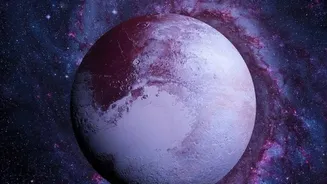
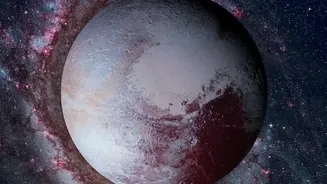
When NASA's New Horizons spacecraft flew past Pluto in 2015, it revealed a stunning, heart-shaped glacier of frozen nitrogen larger than Texas and Oklahoma combined. This feature, known as Sputnik Planitia, immediately captivated scientists and the public.
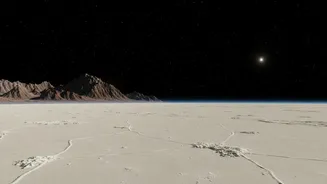
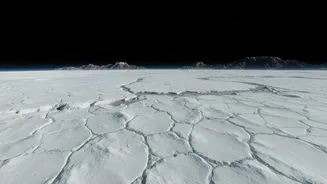
Now, a new analysis of those decade-old images provides the most compelling case yet that this is not just a static ice field. Researchers believe that liquid nitrogen may be seeping up from beneath the glacier, flowing across the surface, and then refreezing. Dark streaks and patches seen along the boundaries of large, city-sized cells of ice are the key pieces of evidence. According to Alan Stern, the principal investigator for the New Horizons mission, "Pluto never stops surprising us."
The Scientific Detective Work
So how did scientists arrive at this startling conclusion without actually seeing liquid? The answer lies in a process of careful inference and comparison. The dark features on Sputnik Planitia look remarkably similar to patterns seen on glaciers in Greenland, where liquid water has darkened the ice. On Pluto, rain is physically impossible, so any liquid must be coming from below. Computer models led by researchers at the SETI Institute and Southwest Research Institute showed that nitrogen ice at the base of the kilometers-deep glacier could melt due to Pluto's modest internal heat. This liquid nitrogen, being less dense than the solid ice above it, would become buoyant. It could then be forced up through cracks and fissures, flowing onto the surface for a time before freezing solid and leaving behind the tell-tale dark stains.
Why Inference is Necessary
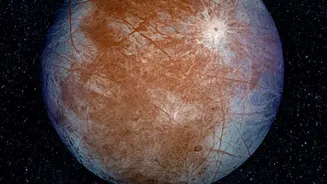
The headline's emphasis on "inference, not direct detection" is a crucial part of the story. We cannot send a probe to drill through miles of ice on a world billions of miles away. Instead, planetary scientists must act like detectives, assembling clues from the data they have. Direct detection of subsurface oceans, for example on Jupiter's moon Europa, often relies on instruments like magnetometers that can detect the magnetic field generated by a salty, conductive ocean. Another method involves using ice-penetrating radar, which is planned for future missions to the moons of Jupiter. For Pluto, where such data isn't available, scientists must rely on visual evidence and geophysical modeling. They observe surface features, like the streaks on Sputnik Planitia or the giant cryovolcanoes like Wright Mons, and then work backward to determine what internal processes could have created them.
Not Just Nitrogen
The potential for liquid nitrogen near the surface is just one part of a larger, even more tantalizing story: the possibility of a vast, liquid water ocean deep beneath Pluto's entire ice shell. For years, scientists have seen clues pointing to this conclusion. The presence of giant tectonic fractures suggests Pluto's crust has expanded over time, something that would happen if a subsurface ocean were slowly freezing. Furthermore, the existence of massive cryovolcanoes—ice volcanoes that spew a slushy mix of water and other chemicals like ammonia—is hard to explain without a persistent source of liquid below. Ammonia acts as an antifreeze, lowering the freezing point of water and making it more plausible for a liquid ocean to survive within a world as cold as Pluto. While still a matter of inference, the general consensus among planetary scientists is that Pluto likely has an ocean today.
A New Class of World
Before New Horizons, Pluto was thought to be a geologically dead ice ball. The discoveries of flowing glaciers, ice volcanoes, and the strong potential for both liquid nitrogen and a deep water ocean have shattered that view. It places Pluto in a category with the icy moons of Jupiter and Saturn, like Europa and Enceladus, as a potential "ocean world." This completely changes our understanding of where liquid water—a key ingredient for life as we know it—can exist. If a small, distant body like Pluto can generate enough internal heat to maintain liquid, it dramatically expands the number of potentially habitable worlds in our galaxy. These findings suggest that similar processes could be at play on other distant dwarf planets in the Kuiper Belt, transforming our view of the outer solar system from a frozen wasteland into a region of hidden, active worlds.