





A Celestial Masterpiece Revealed
Not every star goes out with a bang. Stars similar in mass to our own Sun end their lives in a more gradual, yet visually spectacular, process. After exhausting their nuclear fuel, they shed their outer layers, creating what is known as a planetary nebula.
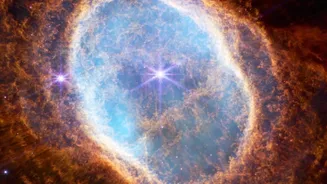
This name is a historical misnomer; they have nothing to do with planets but appeared as faint, fuzzy discs to early astronomers. One of the most stunning examples recently captured by the James Webb Space Telescope (JWST) is the Southern Ring Nebula, or NGC 3132, located about 2,500 light-years away. The images show a complex structure of expanding shells of gas and dust, providing an unprecedented look at this end-of-life process. These intricate patterns of glowing gas are the final, fleeting farewell of a dying star.
The Dying Star and its Hidden Partner
At the heart of the Southern Ring Nebula lies not one, but at least two stars. The star responsible for creating the nebula is now a white dwarf—a tiny, incredibly hot and dense stellar core. This white dwarf, once a star nearly three times the mass of our Sun, has cast off its outer layers over thousands of years. However, Webb's observations revealed a crucial detail that helps explain the nebula's asymmetrical shape: the white dwarf has a companion star. This companion, which is not visible in all images, actively influences the shape of the shells. It orbits the white dwarf, stirring and distributing the ejected gas and dust, much like a whisk beating an egg. This gravitational dance is responsible for creating the complex, non-spherical structures we see, a common feature in planetary nebulae that has long puzzled scientists.
Seeing in Different Light with NIRCam and MIRI
To capture these stunning details, the JWST used two of its key instruments: the Near-Infrared Camera (NIRCam) and the Mid-Infrared Instrument (MIRI). These tools see the universe in infrared light, which is invisible to the human eye. NIRCam excels at imaging the hotter gas illuminated by the central stars, revealing the fine filaments and structure within the shells. Meanwhile, MIRI is sensitive to longer, mid-infrared wavelengths, allowing it to peer through the gas and see the cooler dust. In the case of the Southern Ring Nebula, MIRI revealed for the first time a dusty disk cloaking the white dwarf, a tell-tale sign of a close companion star that has been siphoning off material. By combining data from both instruments, astronomers can create a complete picture of the nebula's components—hot gas, cool dust, and multiple stars—and how they interact.
How the Shells Get Their Shape
The shaping of a planetary nebula is a dynamic process. The dying star doesn't shed its layers all at once. Instead, it happens in pulses, creating concentric shells of material, similar to the layers of an onion. The central white dwarf then lights up this ejected material with its intense radiation, causing the gas to glow. Webb's images show at least eight distinct shells around the Southern Ring's central star, each corresponding to a different mass-loss episode. The presence of a companion star complicates this process, preventing the material from simply expanding in a sphere. Its orbit can stretch the shells into oblong shapes, create pinched waists like an hourglass, or even form spiral patterns in the outflowing material. These new observations provide direct evidence for how binary star systems sculpt these beautiful cosmic structures.