
A New Look at Our Star
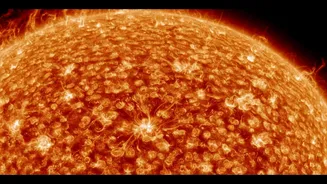
The latest remarkable portrait of our sun comes from the National Science Foundation's Daniel K. Inouye Solar Telescope in Hawaii, the most powerful solar telescope in the world. While often associated with NASA's broader space research, this ground-based
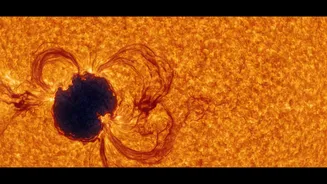
observatory has provided an exceptionally sharp view of the sun's surface in visible light, resolving features as small as 18 miles across. The image looks less like the tranquil yellow ball we know and more like a close-up of boiling caramel or a field of golden popcorn. This mottled pattern is the sun's photosphere, and each of the millions of individual 'kernels' is a structure known as a solar granule.
The Sun's Boiling Surface
So, what exactly are solar granules? Think of a pot of boiling water. Heat from the bottom rises, cools at the surface, and sinks back down, creating a churning motion called convection. The sun's surface works in a similar, but far more dramatic, way. Each granule is the top of a massive convection cell. Hot, bright plasma from the sun's interior rises in the center of the granule, giving it a bright appearance. As this plasma spreads out, it cools and becomes denser, sinking back down into the sun along the darker, cooler lanes between the granules. This process is incredibly dynamic. A single granule, which can be over 1,500 kilometers across—roughly the size of Texas—only lasts for about 10 to 20 minutes before dissipating and being replaced by a new one.
More Than Just a Pretty Picture
Observing these granules in such fine detail is more than just a technical achievement; it's a major step forward in solar physics. For decades, scientists have theorized about certain small-scale phenomena occurring on the sun's surface that were too small to see directly. The new high-resolution images recently confirmed the existence of a process called the Kelvin-Helmholtz instability at the edges of these granules. This occurs when fluids—or in this case, plasmas—move past each other at different speeds, creating swirling vortices similar to how wind creates waves on water. Identifying these tiny swirls is crucial because they may hold the key to solving one of solar science's biggest mysteries: why the sun's outer atmosphere, the corona, is hundreds of times hotter than its visible surface.
From Solar Physics to Space Weather
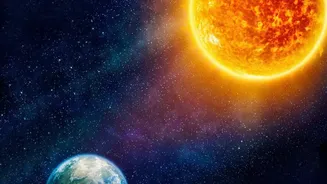
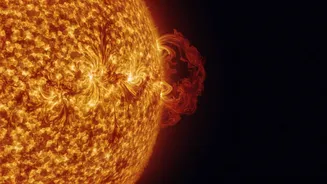
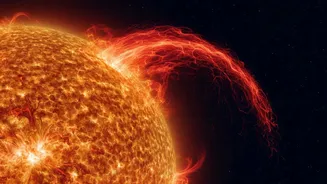
Understanding the fundamental processes on the sun's surface has direct practical implications for us on Earth. The same magnetic energy that shapes the tiny swirls at the edge of solar granules can, on a much larger scale, power enormous solar flares and coronal mass ejections (CMEs). These solar storms send torrents of charged particles hurtling through space. When aimed at Earth, they can create what is known as space weather, which has the potential to disrupt our technological infrastructure. Severe space weather can damage satellites, interfere with GPS and radio communications, and even destabilize electrical power grids. By studying the sun at the most granular level, scientists hope to build better models to predict when these major solar events might occur, giving us time to protect our vulnerable systems.