


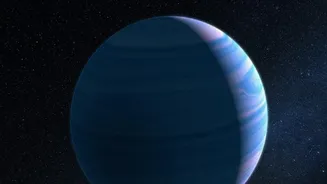
A Well-Known Cosmic Neighbour
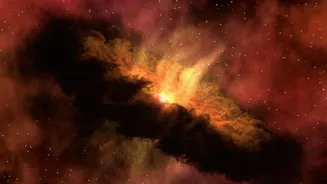
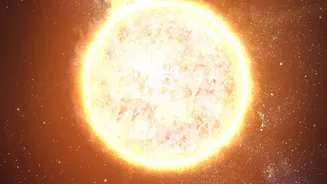
The Beta Pictoris system has long been a favourite subject for astronomers. Located just 63 light-years from Earth, it provides a rare opportunity to observe a young planetary system in action. At only about 23 million years old, it's a stellar infant
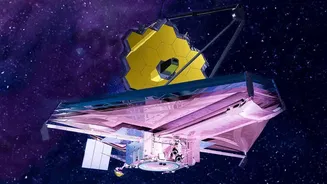
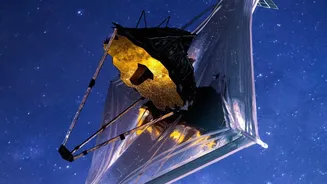
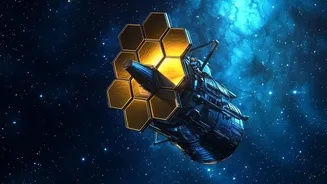
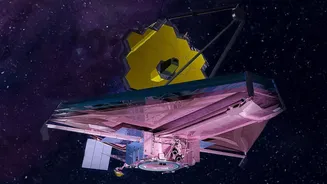
compared to our own 4.5-billion-year-old solar system. Before this latest discovery, scientists knew of two massive gas giants orbiting the star: Beta Pictoris b and Beta Pictoris c. Beta Pictoris b was one of the very first exoplanets to ever be directly photographed, making the system a cornerstone for understanding how planets form and interact with the dusty, gassy disk left over from their star's birth. The research team was using the James Webb Space Telescope's powerful Near-Infrared Spectrograph (NIRSpec) to learn more about Beta Pictoris b when an unexpected signal appeared in their data.
An Unexpected Discovery
The team wasn't hunting for a new planet. Their goal was to analyse the atmosphere of the known world, Beta Pictoris b. But the data revealed another source of light. In astronomy, unexpected bright spots can often be background stars or glitches in the data. However, Webb’s capabilities allowed the scientists to do more than just see the spot; they could analyse its chemical makeup. By splitting the object's light into a spectrum, like a rainbow, they identified the tell-tale molecular fingerprints of a planetary atmosphere, detecting methane, carbon monoxide, and water vapour. This confirmed their suspicions: they had found a third planet, which has now been named Beta Pictoris d. In a remarkable example of scientific corroboration, an independent team using the European Southern Observatory's Very Large Telescope in Chile also identified the planet, even finding faint traces of it in archival data stretching back 11 years.
Meet the New World: Beta Pictoris d
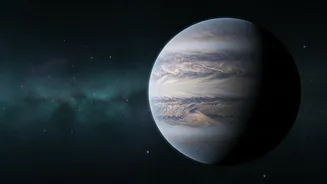
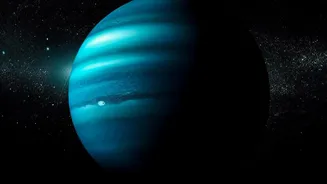
So, what is this newly found giant world like? Beta Pictoris d is a gas giant, similar to Jupiter and its two sibling planets in the system. However, it is the smallest of the three, with an estimated mass about two to two-and-a-half times that of Jupiter. This makes it one of the lightest exoplanets ever to be directly imaged from Earth. It follows a wide orbit around its star, much farther out than its neighbours, at a distance comparable to Neptune's in our solar system. Because it is smaller and farther from its star's warmth, it is also cooler and significantly fainter, about 100 times fainter than Beta Pictoris b, which explains why it remained hidden for so long.
A New Method for Finding Planets
The discovery of Beta Pictoris d is more than just adding another planet to the cosmic census. It showcases a powerful new technique for finding worlds that are otherwise hidden by the glare of their star or, as in this case, a bright disk of cosmic dust. Instead of relying solely on taking a direct picture—a method called coronagraphic imaging—the Webb team found the planet by identifying the chemical signature of its atmosphere. This method, known as moderate-resolution spectroscopy, allows astronomers to filter the scene by chemistry. Dust and gas in a debris disk don't have the same specific combination of methane and water signatures as a giant planet's atmosphere, allowing the planet to stand out. This capability could prove revolutionary for discovering planets in complex, messy environments where traditional imaging fails.
Why This Discovery Matters
Finding a third giant planet makes the Beta Pictoris system an even more valuable natural laboratory for studying planetary evolution. It is now only the second system known to have at least three directly imaged planets, after HR 8799. Astronomers had previously theorised that an unseen planet might be responsible for shaping some of the unusual structures seen in the system's debris disk. The discovery of Beta Pictoris d provides a likely candidate for that long-theorised cosmic sculptor. This complete picture of the system will help scientists refine their models of how multi-planet systems form, how the worlds interact with each other, and how they influence the dusty environment around them. It's a significant piece added to a fascinating and closely watched cosmic puzzle.