




The Tandem Technology Leap
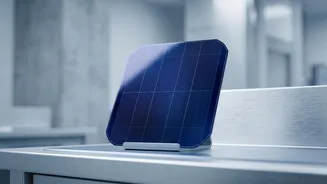
For decades, the vast majority of solar panels have been built using silicon. While reliable and increasingly affordable, silicon-only cells are approaching their theoretical efficiency limit, known as the Shockley-Queisser limit, which is around 33.7%.
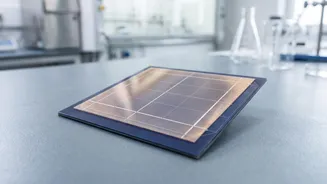
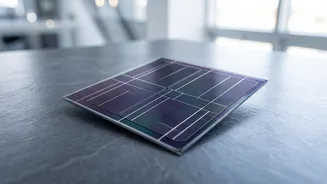
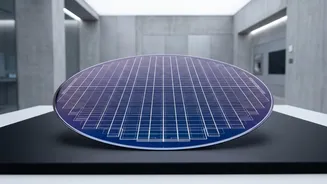
Most commercial panels today operate well below this, often in the 20-25% range. This is where tandem solar cells come in. Instead of relying on a single material, they stack multiple layers of light-absorbing materials. The most promising combination right now involves pairing a traditional silicon cell with a layer of a crystalline material called perovskite. The idea is simple but powerful: the top perovskite layer captures high-energy light (like blue light), while the bottom silicon layer absorbs the lower-energy light (like red light) that passes through. This teamwork allows the cell to convert a much broader spectrum of sunlight into electricity, dramatically boosting its overall efficiency beyond what silicon could ever achieve alone.
Why 30 Percent Is a Game-Changer
Breaching the 30% efficiency threshold is more than just a new record; it's a psychological and economic milestone. Several research groups and companies have recently announced certified results surpassing this number. For instance, U.S.-based Tandem PV announced a 30.4% efficiency for a demonstration module, a significant step as it was built using scalable manufacturing processes. Chinese solar giant LONGi has also been consistently breaking records, recently announcing a certified efficiency of 35.5% for its crystalline silicon-perovskite tandem cell. This level of performance was once considered a distant dream for commercially viable solar technology. Higher efficiency means generating more power from the same amount of space. This is critical for reducing the overall cost of solar energy, as it lowers land, installation, and hardware costs per watt of electricity produced. For both sprawling solar farms and residential rooftops, getting more power from each panel is the key to accelerating the energy transition.
The Perovskite Promise and its Hurdles
Perovskites are at the heart of this breakthrough. They are relatively cheap to produce and remarkably good at converting sunlight into electricity. However, they have historically faced a major challenge: durability. Early perovskite cells degraded quickly when exposed to moisture, oxygen, and heat, making them unsuitable for long-term outdoor use. But recent innovations are rapidly overcoming these stability issues. Scientists are developing new protective layers and molecular additives that make the cells more robust and prevent the degradation that has held back commercialization. While challenges remain in scaling up production from small lab cells to large, uniform panels that can last for 25 years, the pace of progress is incredibly fast. Experts who once saw perovskites as a lab-only curiosity now believe tandem panels could be commercially available within the next five years.
Implications for India's Solar Mission
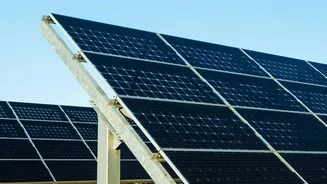
For India, this technological leap is arriving at a crucial moment. The nation has incredibly ambitious renewable energy goals, aiming for 280 GW of solar capacity by 2030 as part of a larger 500 GW renewable target. India has already made stunning progress, increasing its installed solar capacity from just a few gigawatts a decade ago to over 160 GW today. However, achieving the next phase of this expansion comes with challenges, particularly concerning land use. Higher-efficiency tandem solar panels could be a powerful solution. By generating up to 20-30% more power from the same area, they would allow India to meet its targets using significantly less land. This is especially vital in a densely populated country. Furthermore, as this technology matures and costs fall, it could help drive down the price of solar power even further, reinforcing India’s position as a global leader in affordable clean energy. The government's push for domestic manufacturing through schemes like the Production Linked Incentive (PLI) could also create a prime opportunity for India to become a hub for producing these next-generation solar panels.