



Prague's Historic Heart
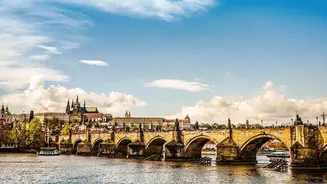
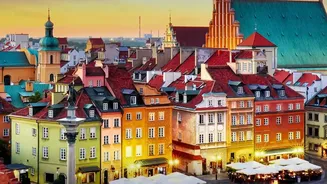
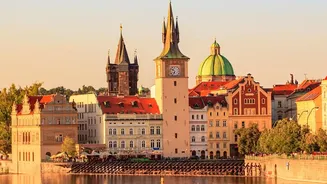
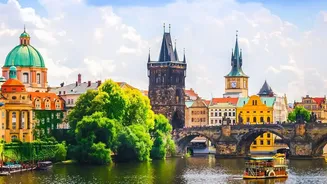
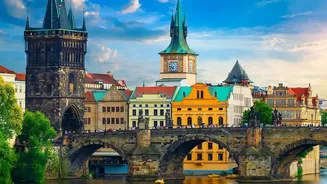
The journey begins in the fairytale capital of the Czech Republic. The entire historic centre of Prague is a UNESCO site, a sprawling masterpiece of Gothic, Renaissance, and Baroque architecture that has captivated visitors for centuries. Stand on the iconic
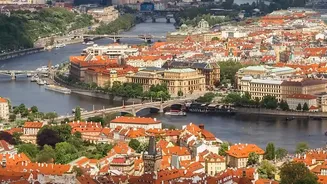
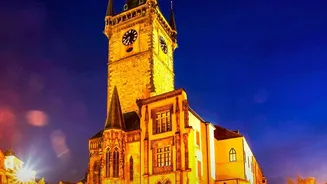
Charles Bridge at dawn, watch the astronomical clock strike the hour in the Old Town Square, and wander the vast complex of Prague Castle overlooking the Vltava River. The city reads like a history book, with every cobblestone street and hidden courtyard telling a story of kings, artists, and alchemists. It’s a place that was the political, cultural, and economic centre of medieval Central Europe and remains one of the world's most beautiful and preserved urban landscapes.
Kutná Hora's Silver Legacy
Just an hour's train ride from Prague lies Kutná Hora, a town whose wealth once rivalled the capital's. Its prosperity was built on prolific silver mines, which funded the construction of some of Bohemia's most spectacular buildings. The UNESCO site here includes the breathtaking late-Gothic St. Barbara's Cathedral, a testament to the miners' ambition and devotion, and the Cathedral of Our Lady at Sedlec. While the nearby Sedlec Ossuary, or 'Bone Church', is a macabre tourist magnet decorated with thousands of human skeletons, the official heritage site celebrates the town's architectural influence across Central Europe and its perfectly preserved medieval character.
Budapest, Pearl of the Danube
Crossing into Hungary, the trail leads to its magnificent capital, Budapest. The UNESCO designation here is extensive, covering the banks of the Danube, the historic Buda Castle Quarter, and the elegant Andrássy Avenue. The Buda Castle Quarter is a district of historic buildings and landmarks, including the Royal Palace and Matthias Church. Across the river, the grand Parliament building dominates the Pest skyline. Andrássy Avenue, added to the site in 2002, represents the city's transformation into a modern metropolis in the 19th century, complete with the continent's first underground railway. Budapest offers a stunning panorama of Hungarian history, from Roman ruins to Art Nouveau grandeur.
The Living Village of Hollókő
For a complete change of pace, the trail veers into rural northern Hungary to Hollókő. This small, traditional village is a unique UNESCO site because it is a living community, deliberately preserved to show rural life before the 20th century's agricultural revolution. First inscribed in 1987, Hollókő is an exceptional example of a Palóc settlement, with its distinctive whitewashed, veranda-style houses topped with wooden balustrades. The village, which developed mainly in the 17th and 18th centuries, feels like stepping back in time. It provides a rare glimpse into the folk traditions, architecture, and agricultural practices that have shaped this region for hundreds of years, offering a peaceful and authentic cultural experience.
Sighișoara's Medieval Citadel
Entering Romania, the next stop is the storybook town of Sighișoara in the heart of Transylvania. Its historic centre is one of the best-preserved and still inhabited medieval citadels in Europe. Founded by German craftsmen and merchants known as the Transylvanian Saxons in the 12th century, the town is a warren of cobbled streets, colourful burgher houses, and ornate churches. Nine defensive towers still punctuate the old city walls. Sighișoara is perhaps most famous as the birthplace of Vlad the Impaler, the historical figure who inspired Bram Stoker's Dracula, but its true magic lies in its authentic medieval atmosphere.
The Wild Danube Delta
The trail concludes where the mighty Danube River meets the Black Sea. The Danube Delta is Europe's second-largest and best-preserved delta, a vast and wild wetland paradise. A UNESCO natural heritage site, it is a labyrinth of lakes, channels, and reed-covered islands. This dynamic ecosystem is a haven for wildlife, boasting the third-largest biodiversity in the world, surpassed only by the Great Barrier Reef and the Galapagos. It is a critical stopover for migratory birds and home to over 300 bird species, including the largest population of great white pelicans in Europe, along with 45 species of freshwater fish. Exploring its tranquil waterways by boat offers a serene and powerful end to a journey through centuries of human history, culminating in a landscape shaped purely by nature.