




What Was the Maunder Minimum?
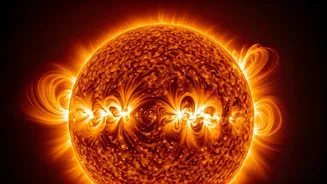
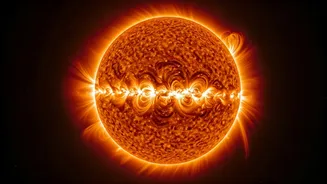
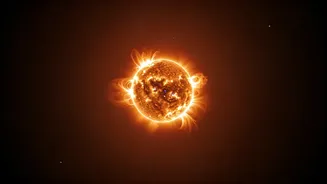
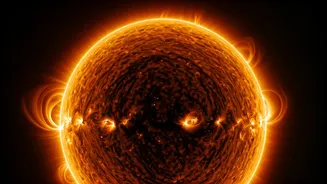
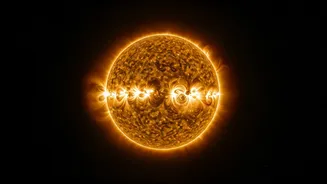
Between roughly 1645 and 1715, astronomers of the era, including prominent figures like Gian Domenico Cassini, noticed something bizarre: the sun had lost its spots. Sunspots, which are dark, cool patches on the solar surface driven by intense magnetic
activity, normally follow a predictable 11-year cycle of boom and bust. But during this 70-year period, they became exceedingly rare. In one 28-year span, fewer than 50 sunspots were observed, compared to the tens of thousands that would typically be seen today over a similar timeframe. This prolonged solar siesta coincided with the middle part of the “Little Ice Age,” a period of cooler temperatures in Europe and North America, famously marked by events like the freezing of the River Thames in London. While the connection is still debated by scientists—many argue volcanic activity was the main driver of the cooling—the sun’s dramatic change in behaviour has remained a fascinating scientific puzzle.
The Sun’s Rhythmic Heartbeat
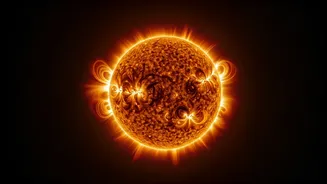
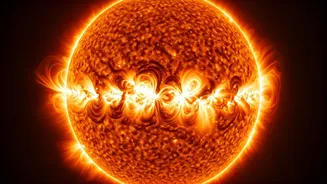
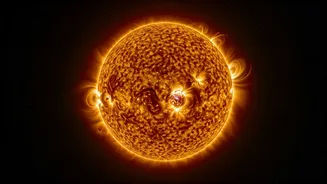
To understand why the Maunder Minimum is so strange, it helps to understand the sun’s normal behaviour. Our star operates on a roughly 11-year cycle, driven by a complex internal engine called the solar dynamo. This process involves the twisting and churning of the sun's magnetic fields within its convective zone. Think of it as a cosmic lava lamp, where hot plasma rises, cools, and sinks, tangling up magnetic field lines. This tangled magnetic energy eventually bursts through the surface, creating sunspots. Over 11 years, this activity ramps up to a “solar maximum,” with many sunspots, and then quiets down to a “solar minimum.” For this cycle to just stop for seven decades has led to theories that the solar dynamo itself had somehow broken or entered a completely different, unusual state.
Did the Cycle Just Get Shorter?
The idea that the sun's fundamental cycle changed has been a leading explanation. Some theories required special conditions to suppress the dynamo or throw it out of whack. Recent research, however, offers a different perspective that challenges this assumption of a 'strange' cycle. Analysis of historical Korean records of auroras—the northern and southern lights, which are also driven by solar activity—suggests the sun’s cycle didn't stop, but may have shortened. A 2023 study published in AGU Advances found evidence of a persistent, but quicker, 8-year cycle during the Maunder Minimum. This implies the solar dynamo was still churning away, just in a different mode, which resulted in far less surface activity. This doesn't entirely solve the mystery, but it reframes the question: not 'why did the sun stop?', but 'why did it change its rhythm?'
A Natural Fluctuation, Not a Freak Event
The latest thinking, bolstered by sophisticated computer simulations of the solar dynamo, moves away from the idea of the sun being 'broken' during the Maunder Minimum. Instead, these long quiet periods might be a natural, albeit rare, feature of how stars like ours behave. Scientists now propose that grand minima are not caused by a different kind of solar cycle, but by the natural, random fluctuations within the existing dynamo system. Just as a river's flow can vary, sometimes leading to unusual droughts or floods, the sun's energy-transport processes can experience random variations that, on rare occasions, align in a way that significantly suppresses magnetic activity for decades. Studies of cosmogenic isotopes in lake sediments and ice cores suggest the sun has entered these minima 18 times in the last 8,000 years, spending up to a quarter of its time in these quiet states. This suggests the Maunder Minimum wasn't a freak event, but a statistical inevitability.
Why This New Understanding Matters
Moving from a 'strange cycle' to a 'natural fluctuation' model has significant implications. It helps physicists refine their understanding of the solar dynamo, the engine that powers not just sunspots but also solar flares and coronal mass ejections that can affect our technology on Earth. It also helps contextualize discussions about a future grand minimum. While some have speculated that a new minimum could counteract modern global warming, the scientific consensus is that the cooling effect would be minor compared to the warming driven by human activities. Understanding these long-term solar variations as a normal part of the sun's life allows for more accurate predictions and a clearer picture of the complex relationship between our star and Earth's climate.