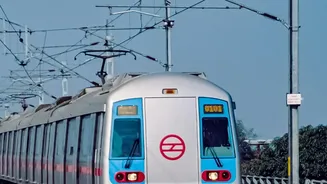








A high-speed rail link promises to slash travel time between Delhi and key Haryana cities, integrating the region like never before. But while the Namo Bharat plan spells a clear win for commuters, its impact on property values is less certain.
What is the Namo Bharat Corridor?
The Delhi-Panipat-Karnal
corridor is a key part of India's larger Namo Bharat plan, officially known as the Regional Rapid Transit System (RRTS). This network is designed to connect major urban and industrial centres across the National Capital Region (NCR) with a system of semi-high-speed trains. Unlike a metro system, which serves a single city, the RRTS is built for longer-distance regional travel, aiming to reduce dependence on road transport. The trains are expected to have an operational speed of 160 km/h, drastically cutting down journey times. This specific corridor, stretching approximately 136 km, will originate in Delhi and connect the major Haryana towns of Sonipat, Gannaur, Samalkha, Panipat, and Karnal, running parallel to the busy National Highway 44.
A Game-Changer for Commuters
For the thousands who travel daily between Haryana and Delhi for work, education, or business, the project is a game-changer. The journey from Delhi to Panipat, which can currently take over two hours by road, is expected to be reduced to just one hour. The trip to Karnal could be cut from nearly four hours to about 90 minutes. With trains planned to run every five to ten minutes, the corridor will offer a reliable and fast alternative to congested highways. The line will start from Sarai Kale Khan in Delhi, a major transport hub that will allow for seamless interchange with other RRTS lines, the Delhi Metro, and interstate bus services. With 22 stations proposed along the route, the corridor will significantly improve access to employment hubs, educational institutions like Rajiv Gandhi Education City in Sonipat, and industrial areas.
The Property Value Question
Major infrastructure projects almost always trigger speculation in the real estate market, and the Delhi-Panipat corridor is no exception. Real estate experts predict that improved connectivity will make cities like Sonipat and Panipat more attractive residential options for those priced out of the Delhi and Gurugram markets. The Haryana government has included the corridor in its Transit-Oriented Development (TOD) policy, which encourages the growth of high-density mixed-use developments around transit stations. This is expected to fuel demand for residential apartments, commercial spaces, and other amenities. However, experts also caution against assuming an automatic price boom. The actual impact on property values will depend on the project's timely completion, the quality of last-mile connectivity from stations, and broader economic conditions. Furthermore, some analysts note that prices in areas near the proposed route have already seen an increase based on speculation, meaning some of the potential gains may already be factored in.
Current Status and The Road Ahead
The project has received crucial approvals from the Haryana government and the National Highways Authority of India (NHAI), which has cleared land use for construction along the highway. As of late 2026, the project, with an estimated cost of around ₹33,051 crore, is awaiting final sanction from the Union Cabinet. The National Capital Region Transport Corporation (NCRTC), the agency executing the project, has already started preliminary work, such as utility shifting, along a 22-km stretch between Narela and Murthal. While the target for completion is set for 2030, this timeline depends on the final approvals and the complex construction process. The success of the fully operational Delhi-Ghaziabad-Meerut RRTS corridor, the first of its kind, serves as a promising blueprint for this next phase of regional connectivity.