






Earth's Restless Outer Shell
To understand Japan’s situation, we first need to picture the Earth’s surface not as a single, solid piece, but as a jigsaw puzzle of massive rock slabs called tectonic plates. These plates are in constant, slow-motion movement, floating on the semi-molten
layer of the Earth's mantle below. They grind past each other, pull apart, or collide. It is at these boundaries where most of the planet's dramatic geological events, like volcanic eruptions and earthquakes, occur. Japan's islands are located in one of the most complex and active areas on the globe, known as the Pacific Ring of Fire, a nearly 40,000-kilometre horseshoe-shaped zone of intense seismic and volcanic activity. This region accounts for roughly 90% of the world's earthquakes.
The Great Plunge: What is Subduction?
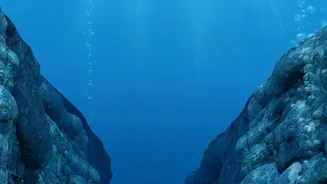
When two tectonic plates collide, the denser plate is often forced to bend and slide beneath the lighter one. This process is called subduction. Off the eastern coast of Japan, the massive Pacific Plate, which forms a large part of the Pacific Ocean floor, is moving westwards at a rate of about 8 to 9 centimetres per year. It collides with and dives under the Okhotsk Plate (sometimes considered part of the larger North American Plate), upon which northern Japan rests. This colossal plunge creates one of the world's deepest oceanic trenches, the Japan Trench, and sets the stage for powerful seismic events.
A Four-Way Tectonic Junction
Japan's geological predicament is particularly complex because it sits at the intersection of not just two, but four major tectonic plates: the Pacific Plate to the east, the Philippine Sea Plate to the south, and the Eurasian and Okhotsk (or North American) plates that form the landmass itself. While the Pacific Plate subducts in the north, the Philippine Sea Plate is diving beneath southern Japan. This unique and unstable foundation means that the entire archipelago is constantly being squeezed, stretched, and stressed from multiple directions, making frequent tremors and occasional powerful quakes an unavoidable feature of life.
How Subduction Creates 'Megathrust' Earthquakes
The process of one plate sliding under another is not smooth. For decades or even centuries, the plates can become locked together by immense friction. While locked, the overriding plate continues to be pushed, causing it to compress and deform, storing up an incredible amount of strain energy like a bent spring. Eventually, the stress overcomes the friction, and the plates violently slip past each other in a matter of minutes. This sudden release of energy creates a massive earthquake known as a 'megathrust' event. These are the most powerful types of earthquakes on the planet, and they almost exclusively occur in subduction zones. The abrupt movement of the seafloor during such an event can also displace a massive volume of water, generating devastating tsunamis.
The 2011 Tōhoku Quake: A Case Study
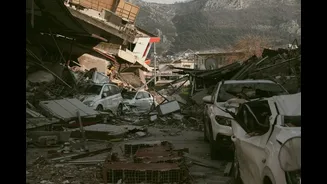
The catastrophic magnitude 9.0 earthquake that struck off the coast of Japan on March 11, 2011, was a textbook example of this process. It was caused by a sudden rupture on the subduction zone interface at the Japan Trench, where the Pacific Plate dives beneath Japan. The rupture zone was enormous, stretching for hundreds of kilometres. The immense energy release moved parts of Japan’s main island, Honshu, several metres to the east and caused the resulting tsunami that led to widespread destruction. It remains the most powerful earthquake ever recorded in Japan and one of the largest in recorded history, a direct consequence of the immense forces at play in this subduction zone.
Living with a Geological Superpower
This constant seismic threat has profoundly shaped Japanese society. In response, the nation has become a world leader in earthquake engineering and preparedness. Since first introducing a seismic building code in 1924 after the Great Kanto Earthquake, Japan has repeatedly updated its regulations after every major quake. Modern buildings employ a range of technologies, from basic reinforcement (taishin) to sophisticated damping systems (seishin) and base isolation (menshin), which allows a building to move independently of the ground's shaking. This focus on resilience, born from living on one of the world's most active geological hotspots, demonstrates a remarkable adaptation to the powerful forces that shape the islands.