







The Fiery Moon We Thought We Knew
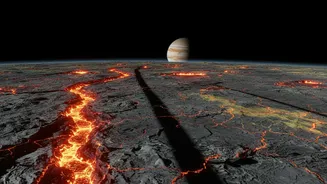
Io is a world of superlatives. Caught in a gravitational tug-of-war between the colossal Jupiter and its other large moons, Io is perpetually squeezed and stretched. This process, called tidal heating, generates immense frictional heat in its interior,
fueling hundreds of volcanoes that cover its surface in sulfurous yellows, reds, and blacks. For decades, our understanding of this volcanic wonderland came from two primary sources: visible light cameras and infrared instruments. Missions like Voyager and Galileo, and more recently Juno's own visible-light camera (JunoCam), have given us stunning pictures of its pockmarked surface, revealing vast lava flows and towering mountains. Infrared instruments, like Juno’s Jovian Infrared Auroral Mapper (JIRAM), added another layer by detecting heat. They allowed scientists to pinpoint active eruptions and measure the temperature of fresh lava, essentially creating a real-time map of surface hot spots. But these methods could only show us the surface. What was happening just beneath the crust remained a mystery.
A New Kind of Vision: The Microwave Breakthrough
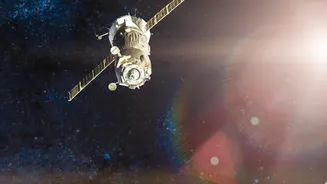
Enter the Microwave Radiometer (MWR), one of Juno’s key instruments. Originally designed to probe hundreds of kilometers beneath Jupiter's dense cloud tops, scientists repurposed this powerful tool during close flybys of Io in late 2023 and early 2024. The decision yielded a groundbreaking discovery: MWR could peer through Io's rocky crust. While visible light shows what something looks like and infrared shows how hot its surface is, microwaves reveal thermal energy from below. The MWR instrument measures microwave radiation at different wavelengths, allowing it to sense temperatures at depths ranging from a few inches to tens of feet into the crust. For the first time, scientists weren't just looking at the eruption on the surface; they were getting a temperature reading of the plumbing system just underneath.
What the Microwaves Revealed
The data from Juno's MWR has painted a new, surprising picture of Io. Everywhere the instrument looked, it found the temperature rising significantly just a few feet below the surface. This heat gradient is far steeper than what solar heating alone could explain, confirming that immense heat is rising from the interior across the moon. The microwave data revealed vast regions of subsurface heat, particularly one massive anomaly near a volcanic complex named Zal Montes Patera, which was 18 to 36 degrees Fahrenheit warmer than its surroundings just below the crust. Scientists were surprised to find evidence of still-warm, cooling magma that hasn't yet solidified, hiding just beneath the surface crust across an estimated 10% of the moon. Additionally, the MWR data showed that outside of its dramatic mountains, much of Io's surface is remarkably smooth over large areas, composed of low-density material.
Building a 3D Picture of a Volcano World
The true power of this new research comes from combining all three types of observation. Think of it like a doctor diagnosing a patient. A visible light camera is like the doctor's eyes, seeing the obvious surface features. An infrared instrument is like a thermal scanner, showing where the fever is. And the new microwave data is like an MRI, revealing what’s happening beneath the skin. By layering visible, infrared, and microwave data, scientists can now build a three-dimensional model of Io's volcanism. They can see a fresh lava flow with JunoCam, confirm it's still hot with JIRAM, and now, with MWR, they can measure the residual heat of the magma system that fed it from below. This multi-faceted approach helps answer fundamental questions about how Io works. It helps explain how the moon so efficiently radiates its internal heat and constantly renews its surface. As Juno principal investigator Scott Bolton noted, being able to see below a rocky moon's surface was an unexpected discovery with major implications, even for studying volcanoes on Earth.