




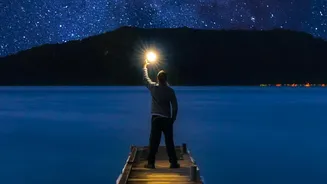
Why Rules Are Essential
At first, the long list of dos and don'ts at an astronomy site can seem restrictive. However, these rules aren't designed to spoil your fun; they are in place to protect incredibly sensitive and expensive scientific equipment and to ensure every visitor
has the best possible experience. Scientific observation often requires absolute priority, meaning visitor activities cannot interfere with research. More importantly, the rules are there to protect a precious, fragile, and shared resource: everyone's night vision.
The Cardinal Sin: White Light and Flashes
The single most important rule is the absolute ban on white light, especially camera flashes. The human eye takes between 30 and 45 minutes to fully adapt to darkness, a process that allows you to see faint celestial objects like nebulae and distant galaxies. A single, brief flash of white light from a phone screen, a torch, or a camera can instantly ruin that dark adaptation for everyone nearby, forcing their eyes to restart the entire process. For this reason, always disable the flash on your camera and phone before you even arrive at the site. Even a car's interior light or a sparking lighter can be disruptive.
Seeing Red: The Right Way to Illuminate
While white light is forbidden, you won't be left to stumble in total darkness. Astronomers use red light because it has a minimal impact on our night vision. The rod cells in our eyes, which are responsible for vision in low-light conditions, are less sensitive to red wavelengths. You should use a torch with a red filter or one that has a dedicated red-light mode. Always point the light towards the ground to avoid shining it at other people or their equipment. Even with red light, be considerate; a bright red light can still ruin a long-exposure photograph.
Gear and Etiquette on the Ground
Astrophotography requires a camera capable of manual control, a wide-angle lens, and a sturdy tripod. However, be mindful of where you set up. Tripods can be trip-hazards in the dark. Many sites have designated areas for photographers. Once set up, try not to touch or move your equipment unless necessary to avoid disturbing delicate calibrations. If you need to make adjustments, use a dim red light and shield it with your hand. Also be aware that seemingly harmless products like aerosol insect repellents can contain chemicals that permanently damage telescope optics; use lotions or wipes instead.
Know Before You Go: Check Local Rules
Rules can vary significantly from one site to another. Professional research facilities often have stricter policies than public dark-sky parks. For example, the Indian Astronomical Observatory (IAO) in Hanle, Ladakh, is a high-altitude research station. While it is one of the best sites in the world for astronomy, visitor access is limited to daytime tours, and you cannot look through the research telescopes. Photography is also restricted, and driving around the facility at night is strictly prohibited to prevent light pollution. Always check the observatory's official website for the latest visitor information, visiting hours, and specific photography policies before your trip.
Beyond the Big Domes
If your primary goal is photography and you find an observatory's rules too restrictive, consider visiting a designated Dark Sky Reserve. These areas, like the Hanle Dark Sky Reserve in Ladakh, are protected from light pollution and are often more accommodating to amateur astrophotographers. Local homestays and tour operators in such regions may even offer specific astrophotography workshops or sessions. These locations provide a fantastic opportunity to practice your skills in a pristine environment while still respecting the night sky.