

The Life and Death of a Sun-Like Star
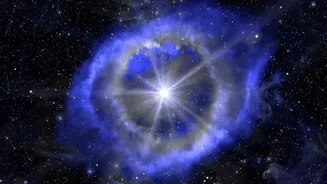
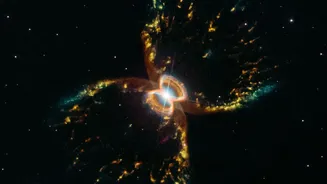
What you're seeing in this magnificent image is a planetary nebula, a name that's a bit of a misnomer, as it has nothing to do with planets. It is, in fact, the final, beautiful act of a star similar to our own Sun. For most of their lives, stars like
these are stable, fusing hydrogen into helium. But as they exhaust their primary fuel, they become unstable, swelling into red giants before puffing their outer layers of gas and dust into space. Left behind at the centre is the star's incredibly hot and dense core: a white dwarf. This white dwarf, the smouldering remnant of a once-mighty star, now illuminates the very material it shed, creating the glowing spectacle we call a planetary nebula.
What Webb's Infrared Eyes Reveal
The Lion Nebula, officially known as NGC 2392, had been observed before by the Hubble Space Telescope, but Webb’s powerful infrared instruments have peeled back new layers of mystery. Webb’s view, a composite from its Near-Infrared (NIRCam) and Mid-Infrared (MIRI) instruments, provides a much clearer look at the nebula's intricate structure. The image reveals a distinct separation between the inner “face” and the outer “mane.” The face is a bubble of intensely hot, ionized gas, being cooked from the inside out by the fierce radiation of the central white dwarf. This expanding bubble is a destructive force, obliterating dust in its path and carving out a vast cavity. This process is what gives the nebula its complex system of shells and rings, a feature common in planetary nebulae that scientists are still working to fully understand.
The Science Locked in the Mane
The most fascinating science may lie in the lion's glorious mane. While the central star’s radiation is destructive, it doesn’t destroy everything. The mane is composed of a shell of dust and gas that has survived the initial blast. Webb’s image highlights clumps of surviving dust and molecular hydrogen within this mane, appearing as vibrant orange and yellow filaments. These dense clumps are cosmic survivors. They have endured the stellar radiation and now act like shields, protecting the material lying behind them. These cometary-like tufts are a forensic goldmine, giving astronomers a direct look at the chemical composition of the material ejected by the dying star. By studying what these stellar remnants are made of, scientists can better understand how stars seed the galaxy with heavier elements like carbon, nitrogen, and oxygen, which are essential for forming new stars, planets, and even life.
A Glimpse of Our Solar System's Future
Looking at the Lion Nebula is like looking at a prophecy for our own solar system. In about five billion years, our Sun will run out of fuel and is expected to create its own planetary nebula. While the resulting spectacle will be a beautiful final act, it signifies the end of the star that has nurtured life on Earth. The process we are witnessing with NGC 2392 is a snapshot in time. The structures Webb has captured took thousands of years to form, and they are constantly changing as the gas and dust expand away from the central star. Astronomers estimate that in about 10,000 years, the Lion Nebula will have completely dispersed, its constituent elements fading back into the interstellar medium to be recycled. It's a fleeting moment on a cosmic timescale, but one that Webb has frozen in time for us to study.