


A Crimson Clue in the Cosmic Dark
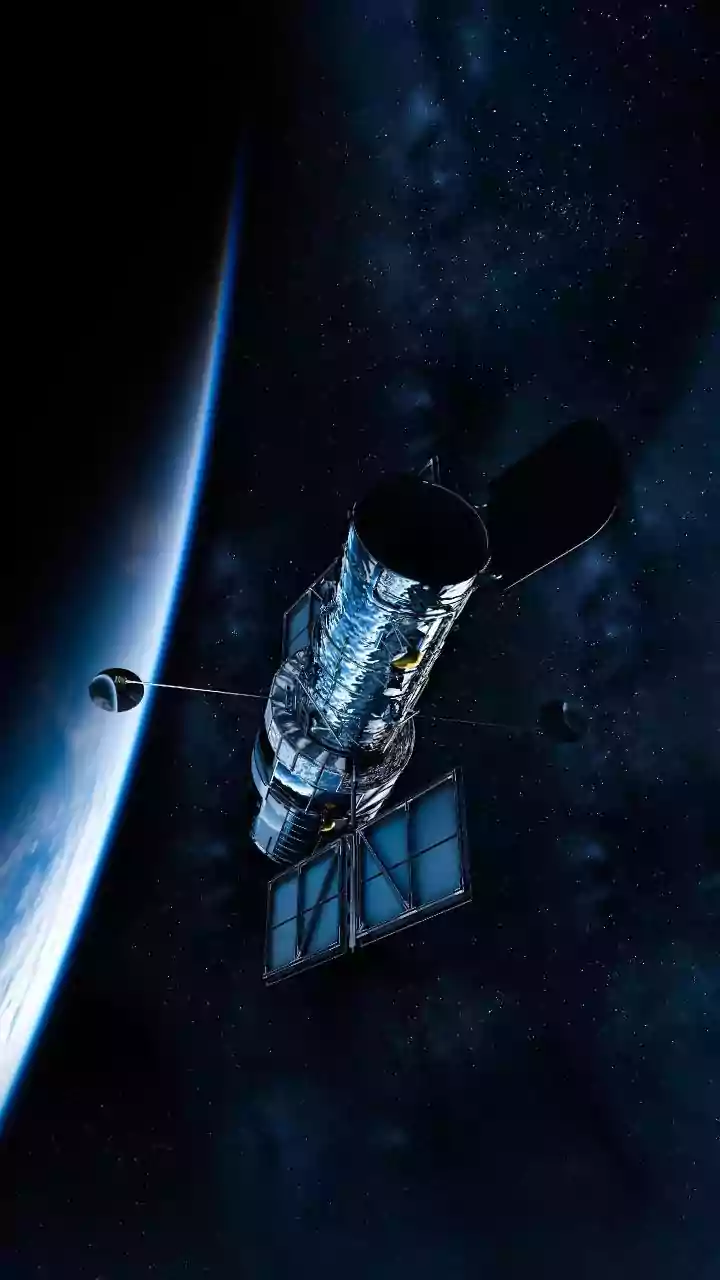
Since it began operations, the JWST has been capturing breathtakingly deep images of the early universe, revealing objects more distant—and therefore older—than humanity has ever seen before. Scattered across these ancient cosmic landscapes are a number
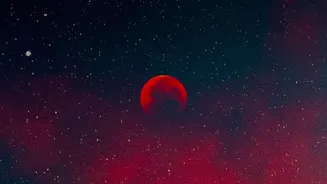
of mysterious, intensely red objects. Initially dubbed "Little Red Dots" by astronomers, these sources are exceptionally bright for their compact size. They appear in images showing a time just a few hundred million years after the Big Bang, a period when the universe was only a fraction of its current age. Their strange properties have sparked a vibrant debate among scientists who are working to figure out exactly what they are.
Why Red and Why So Strange?
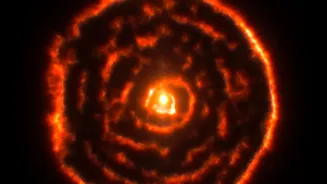
In cosmology, red is a significant color. As the universe expands, the light from distant objects gets stretched on its journey to us. This stretching shifts the light towards longer, redder wavelengths in a phenomenon called "redshift." The redder an object appears, the farther away it is, and the further back in time we are seeing it. These red dots are so red they are clearly from the cosmic dawn. But their brightness is a major puzzle. Some of these objects are blazing with the light of billions of stars, yet they are remarkably small. One particularly striking object, named MoM-BH-1, is about the size of our solar system but shines with 100 billion times more energy than any single star physically could. This extreme energy output is more typical of a supermassive black hole than a galaxy of stars.
A New Type of Object: The 'Black Hole Star'
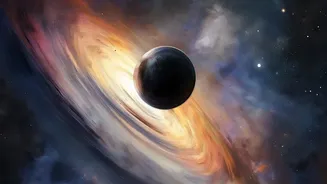
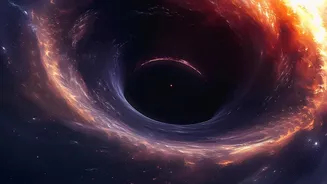
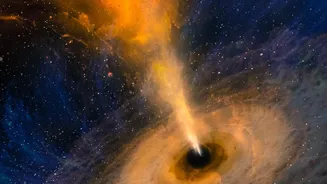
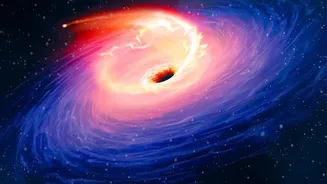
The leading—and most exotic—theory is that at least some of these red dots are an entirely new class of object never seen before: a "black hole star." This isn't a star with a black hole inside it, but rather a nascent supermassive black hole, estimated to be around 100,000 times the mass of our sun, that is feeding so ferociously it has become shrouded in an enormous, dense cocoon of hydrogen gas. In this model, the black hole itself is the engine, providing the colossal energy output. The surrounding gas cloud absorbs and re-emits this energy, making the entire object glow like a gigantic, red star. While normal red objects in space are often colored by dust, analysis of MoM-BH-1 showed its redness was caused by this dense gas, a key clue that something very different was happening.
Rewriting the First Chapter of the Universe
If this hypothesis is correct, it could solve one of the biggest mysteries in modern astronomy: how supermassive black holes grew so big, so fast in the early universe. Standard models suggest it should take billions of years for a black hole to reach such an enormous mass, yet we see them fully formed when the universe was very young. These "black hole stars" might be the missing link—a transitional phase where the seeds of supermassive black holes were growing at an explosive rate, hidden inside their gassy stellar cocoons. This discovery suggests that the first supermassive black holes may have formed differently than we thought, starting their lives as these brilliantly bright red objects before settling down to become the gravitational anchors of the galaxies we see today. What once looked like a simple red dot may in fact be a snapshot of cosmic creation itself.