







A Successful Start for MMX
On October 21, 2026, the Japan Aerospace Exploration Agency (JAXA) announced that the Martian Moons eXploration (MMX) probe successfully completed its 'initial critical operations phase'. This technical-sounding but crucial step means the spacecraft,
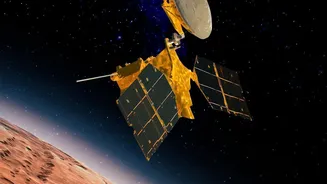
which launched on October 20 from the Tanegashima Space Center, has 'woken up' in space and is functioning as expected. The checks included deploying its solar array panels for power, establishing a stable orientation, and securing its communication antennas for the long journey ahead. With these initial tests passed, MMX is now officially on its way to the Martian system.
The Mission to Mars's Mysterious Moons
MMX is embarking on a world-first mission: to visit Mars's two small moons, Phobos and Deimos, and return a sample from Phobos to Earth. Scientists are deeply divided on how these moons formed. Are they former asteroids captured by Mars's gravity, or are they the remnants of a giant impact on Mars itself billions of years ago? Each possibility tells a different story about the early solar system. By analyzing a physical sample, MMX aims to finally answer this question. The mission plans to collect at least 10 grams of material from the surface of Phobos, the larger of the two moons. The spacecraft is expected to arrive in the vicinity of Mars in August 2027.
An International Effort
While led by Japan, the MMX mission is a significant international collaboration. NASA has contributed a key scientific instrument called MEGANE (Mars-moon Exploration with GAmma rays and Neutrons), which will help map the chemical composition of Phobos's surface. The French and German space agencies, CNES and DLR, have built a small rover named 'IDEFIX'. This rover will be deployed onto Phobos to survey the surface and help mission controllers select the best location for MMX to land and collect its sample. This teamwork highlights a global commitment to uncovering the secrets of our solar system.
What Happens Next?
The journey to Mars will take approximately one year. After arriving in August 2027, MMX will spend about three years conducting detailed observations of both Phobos and Deimos. The spacecraft will enter a special 'quasi-satellite orbit' that allows it to fly close to Phobos repeatedly. This extended survey period is essential for mapping the moon and identifying a safe landing spot. The actual landing and sample collection on Phobos are among the most challenging parts of the mission, scheduled to take place before the spacecraft begins its journey home in 2030. The return capsule, carrying precious cargo from another world, is scheduled to land in Australia in 2031.
Pioneering a New Era of Exploration
This mission builds on the expertise Japan developed during its successful Hayabusa and Hayabusa2 asteroid sample-return missions. MMX represents the next logical step, moving from nearby asteroids to the moons of another planet. It is the first-ever sample return mission attempted from the Martian system. Successfully retrieving material from Phobos will not only provide immense scientific insight but also pioneer the technologies needed for future exploration, including potential human missions to Mars. The mission is a bold statement about Japan's ambitions and its leading role in robotic space exploration.