





The Arctic's Cloudy Climate Role
The Arctic is warming about three times faster than the rest of the planet, a stark reality that has profound global consequences. A key element in this complex system is clouds. Arctic clouds are a double-edged sword: they can trap heat, warming the surface
below, or they can reflect sunlight back into space, providing a cooling effect. Which role they play depends on many factors, including how they are formed. For years, scientists have worked to understand what seeds these clouds in the pristine Arctic air, which has very little of the dust or pollution that typically gives water vapour something to condense onto. A recent study published in Nature Geoscience provides a dramatic new clue, revealing a powerful natural process at the very edge of the ice.
From Melting Ice to Cloud Seeds
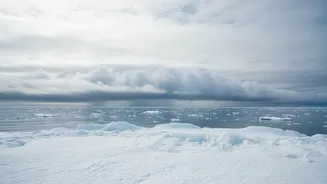
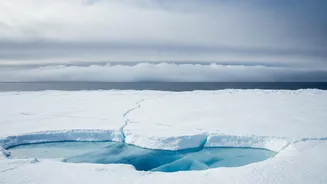
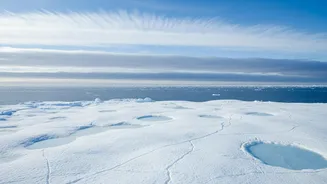
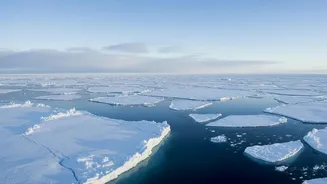
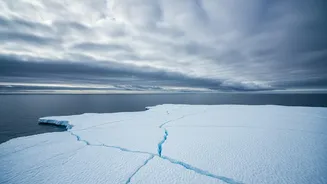
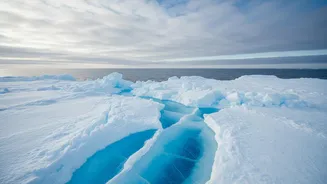
The new research, led by an international team from the University of Birmingham, has provided the first real-world evidence of a mechanism previously only demonstrated in lab experiments. They discovered that at the 'marginal ice zone'—the dynamic border where open ocean meets melting sea ice—a powerful chemical process kicks into gear. This zone is a hub of biological activity, rich in marine algae. As sunlight hits this productive area, it triggers the release of a mixture of iodine, sulphur, and other organic compounds from the water and marine life. These gases rise into the atmosphere and, under sunlight, undergo chemical reactions to create brand new particles. These tiny particles act as 'cloud condensation nuclei', or the seeds around which cloud droplets can form.
A Fifty-Fold Increase in Particles
The effect is anything but minor. During their expedition, researchers observed that this process was happening on over 80% of sunny days. In one instance, they watched the number of particles capable of seeding cloud droplets leap from around 50 per cubic centimetre to 1,500 in a single day—a fifty-fold increase. This explosion in cloud seeds demonstrates that as the Arctic warms and more sea ice melts, the widening marginal ice zone is likely becoming an increasingly intense source of cloud-forming particles. This discovery validates a mechanism involving iodine oxoacids and sulfuric acid that had been theorized but never before confirmed in the real world.
A Surprising Climate Feedback Loop
This finding introduces a fascinating and complex feedback loop into our understanding of the Arctic climate. The primary feedback loop is well known: warming temperatures melt the bright, reflective sea ice, exposing the dark ocean, which absorbs more sunlight and causes more warming. This is a positive feedback loop, accelerating the change. However, the new study suggests a potential counteracting effect, known as a negative feedback loop. As the sea ice melts, it creates more of this particle-generating open water at the ice's edge. This, in turn, can create more clouds. More clouds, particularly over the dark open ocean during summer, could reflect more sunlight away from the surface, introducing a slight cooling effect on the water. This doesn't reverse climate change, but it reveals the intricate and sometimes counterintuitive ways the Earth's systems respond to warming.
What This Means for Climate Models
This natural process is not currently accounted for in most climate models, which struggle to accurately reproduce Arctic cloud and particle measurements. Understanding how natural emissions influence clouds is critical for making accurate predictions about the future of the region. By incorporating this newly understood mechanism—which combines iodine and sulphur chemistry into a single, potent process—scientists hope to improve the models that predict not only how climate change affects the Arctic, but how the Arctic itself influences the global climate. The discovery highlights just how much there is left to learn about the most rapidly changing region on our planet.