
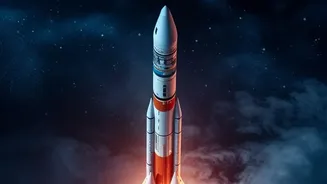

The Dawn of the 'Rocket Revolution'
World Space Week, observed annually from October 4-10, commemorates key milestones in space history: the launch of Sputnik 1 and the entry into force of the Outer Space Treaty. This year’s theme, ‘Rocket Revolution’, spotlights the dramatic transformation
in space launch capabilities. For decades, space was the exclusive domain of a few government agencies with massive budgets. Rockets were built for a single, expensive flight and then discarded. That model is now being disrupted by commercial companies, startups, and new national players who are drastically lowering costs and increasing launch frequency, opening the cosmos to a wider range of participants than ever before.
The Reusability Game-Changer
The single most important factor in this revolution is reusability. Companies like SpaceX, with its workhorse Falcon 9 rocket, have proven that landing and reusing a rocket's first stage is not just possible, but economically transformative. By recovering and reflying the most expensive part of the rocket, launch costs have plummeted. What was once a new vehicle for every mission is now more like an airline model, where the same hardware can be used for dozens of flights. This has reduced the cost to launch a kilogram into orbit from tens of thousands of dollars to just a few thousand, with projections suggesting it could fall to a few hundred dollars by 2040.
Building Rockets Faster and Smarter
Alongside reusability, new manufacturing techniques are accelerating the pace of innovation. Additive manufacturing, or 3D printing, is a key enabler. Companies are now 3D printing complex rocket engine components, and in some cases, nearly entire rocket structures. This approach dramatically cuts down on the number of individual parts, reducing potential points of failure and simplifying assembly. What used to take months or years to build with traditional methods can now be printed in weeks or days. This allows for rapid prototyping and iteration, making it easier for new players to enter the market with innovative designs.
What Cheaper Access Unlocks
Lower launch costs are not just an industry metric; they are the key to unlocking a vibrant low-Earth orbit economy. Cheaper access enables the deployment of large satellite mega-constellations that provide global internet coverage. It makes more frequent and ambitious scientific missions possible, and it brings the prospect of space tourism closer to reality for a broader audience. It also lowers the barrier to entry for universities and smaller nations to launch their own research satellites. While developing and operating satellites remains a complex and expensive endeavour, the falling cost of launch removes one of the biggest financial hurdles.
India's Ascent in the New Space Race
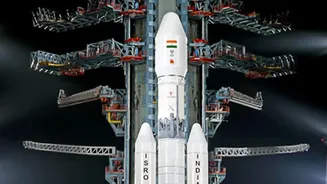
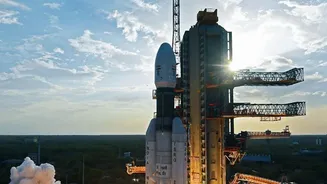
This global revolution has a distinctly Indian chapter. The Indian government's move to open the space sector to private participation in 2020 has catalyzed a startup boom. Companies like Hyderabad-based Skyroot Aerospace and Chennai-based Agnikul Cosmos are at the forefront, developing their own launch vehicles. Skyroot is developing its Vikram series of rockets, while Agnikul is notable for its use of 3D-printed, semi-cryogenic engines for its Agnibaan rocket. These firms are not just supporting ISRO; they are building commercial capabilities to serve a global market, signalling that India's private space industry is ready to compete on the world stage.