





A 'GPS' for the Moon
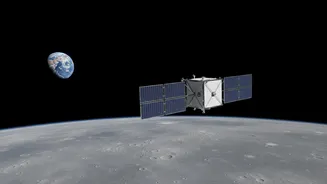
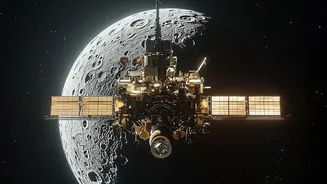
NASA has delivered a compact, powerful navigation receiver called NavCube3-mini to the commercial space company Intuitive Machines. Its destination is the Altus-1 lunar relay satellite, which will become a key piece of infrastructure for future Moon missions.
Think of NavCube3-mini as a pioneering form of GPS for deep space. It's designed to allow spacecraft operating near the Moon to determine their own position autonomously, without constantly needing to 'phone home' to mission control on Earth. This capability is a game-changer for the safety, efficiency, and ambition of the Artemis program, which aims to establish a long-term human presence on and around the Moon.
The Challenge of Deep-Space Navigation
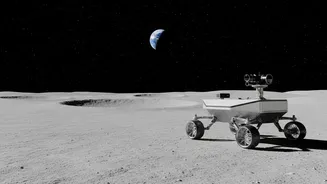
On Earth, we take satellite navigation for granted. But the Global Navigation Satellite Systems (GNSS) we rely on, like the U.S. GPS and Europe's Galileo, were designed for users on or near the planet's surface. Their signals become incredibly weak at lunar distances, over 380,000 kilometers away. For decades, deep-space navigation has relied on ground-based radiometric tracking from networks like the Deep Space Network (DSN). This method is reliable but slow, involving round-trip light-time delays and significant ground-based support, creating a bottleneck as lunar traffic increases. For astronauts in lunar orbit or rovers exploring treacherous terrain like the lunar south pole, the ability to know their precise location in real-time is not a luxury—it's essential for safety and success.
How NavCube3-Mini Works
Developed at NASA's Goddard Space Flight Center, NavCube3-mini is an engineering marvel designed specifically to overcome the challenges of lunar navigation. It features a highly sensitive receiver capable of acquiring and tracking the faint, 'sidelobe' signals from Earth's GNSS constellations that spill out into deep space. By processing signals from both GPS and Galileo, it enhances reliability and accuracy. The real innovation lies in its onboard processing power. The system integrates this GNSS data using sophisticated software, allowing it to calculate its own position, velocity, and time with high precision, independent of Earth. This builds on the heritage of previous NASA technologies, like the Navigator GPS receiver used on the Magnetospheric Multiscale (MMS) mission, but in a much smaller, more efficient package.
Small Size, Huge Impact
In space exploration, size, weight, and power (SWaP) are critical constraints. Every kilogram and every watt is precious. NavCube3-mini excels here. Weighing just 1.6 kilograms (3.5 lbs) and consuming less power than a standard laptop (under 20 watts), it is dramatically smaller and more efficient than its predecessors. Before being delivered to Intuitive Machines, the device underwent a rigorous series of tests simulating the harsh conditions of a rocket launch and the extreme temperatures and vacuum of space to ensure it was ready for its mission. Its small footprint means more room and power can be allocated to scientific instruments and other critical mission payloads, enabling more ambitious science.
The First Stop: A Lunar Relay Network
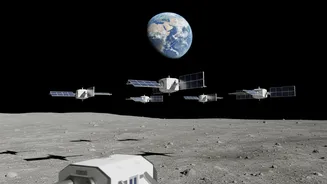
NavCube3-mini's first job is a technology demonstration aboard Altus-1, the first satellite in a planned commercial lunar relay network. This network will provide continuous communication and navigation services for various missions, from orbiters and landers to rovers and eventually astronauts. This is particularly crucial for operations on the far side of the Moon or in polar regions where direct line-of-sight to Earth is often blocked. By proving that GNSS-based navigation is viable at the Moon, NavCube3-mini will pave the way for this essential infrastructure, creating a more interconnected and resilient lunar exploration environment.