





Our Neighbour's Quieter History
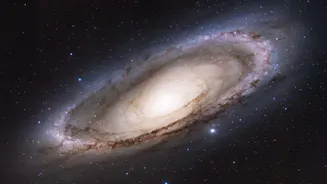
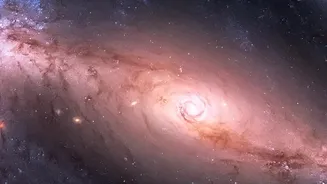
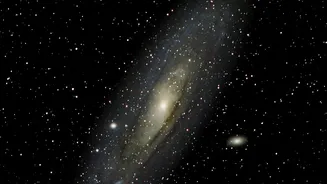
Imagine a bustling city that gradually becomes a quiet town. That's essentially what new research suggests is happening in the Andromeda galaxy. A major study using data from the Hubble Space Telescope has revealed that star formation—the galaxy's ability
to create new stars—has been steadily declining for at least the last 500 million years. The slowdown has become particularly pronounced more recently, with a steep drop over the past 40 million years. While the galaxy had a dramatic burst of star birth about two billion years ago, likely due to a merger with another galaxy, it has since entered a phase of graceful aging.
Cosmic Forensics: Reading the Stars
So how do scientists rewind the history of a galaxy that's 2.5 million light-years away? The answer lies in treating its stars like a fossil record. Astronomers used Hubble to map about two-thirds of Andromeda's sprawling disk, meticulously measuring around 200 million individual stars. The key is that a star's color and brightness reveal its age. Massive stars burn hot and blue but have short lifespans, so their presence indicates recent star birth. Less massive, redder stars live much longer and represent older populations. By analyzing the mix of stars in thousands of different regions across the galaxy, researchers could build a detailed timeline of its star-forming activity over billions of years.
A Fading Ring of Fire
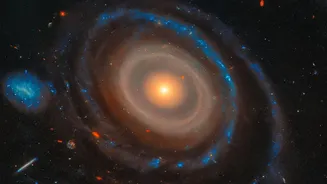
The slowdown isn't happening uniformly. The study found that most of Andromeda's recent star-making has been concentrated in a massive ring of dust and gas located about 32,000 light-years from the galactic center. It is the fading activity within this specific ring that is driving much of the galaxy's overall decline. Five hundred million years ago, Andromeda was creating stars at a rate of about one solar mass (the mass of our Sun) per year. That rate has now plummeted to just one-fifth of a solar mass annually. Rather than running out of the raw gas and dust needed to form stars, the galaxy appears to be naturally winding down from its more active past.
A Tale of Two Galaxies
This discovery inevitably invites a comparison to our own home, the Milky Way. While both are large spiral galaxies in the same cosmic neighborhood, their life stories are quite different. The Milky Way is actually the more active of the two right now, producing about 3 to 5 solar masses worth of stars per year, significantly more than Andromeda's current rate. This suggests our galaxy has had a more quiescent past, while Andromeda's history was marked by more dramatic events and a higher overall efficiency in turning gas into stars. In a way, by studying Andromeda's slowdown, we may be getting a glimpse into the kind of future that could await the Milky Way billions of years from now.
Why a Galaxy's Past Matters
Understanding the lifecycle of galaxies is one of the biggest quests in modern astronomy. By examining our closest large neighbor in such detail, scientists can test and refine their models of how all galaxies form, grow, and eventually age. Andromeda provides a perfect laboratory for studying this process of galactic evolution, from dramatic mergers to the long, slow decline that follows. The evidence suggests Andromeda is in a transitional phase known as the "green valley," moving from an active, star-forming "blue cloud" galaxy to a dormant "red sequence" one. This journey from cosmic youth to old age is a fundamental process in the universe, and Andromeda is giving us a front-row seat.