





A Glimpse into the Distant Future
Earth's continents may seem fixed, but on a geological timescale, they are in constant motion. Driven by the slow churn of tectonic plates, the familiar world map is just a temporary snapshot. Scientists project that in roughly 250 million years, the continents will
once again merge, forming a new supercontinent. One of the most widely discussed possibilities is Pangea Ultima, a massive landmass expected to form as the Atlantic Ocean shrinks, causing the Americas to collide with a merged Afro-Eurasian continent. While the exact shape is a subject of scientific modeling, recent research has focused on a more pressing question: what would its climate actually be like?
A World of Extreme Heat
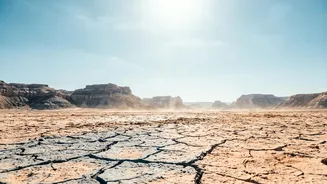
Using sophisticated supercomputer climate models, a team of researchers led by Dr. Alexander Farnsworth of the University of Bristol has simulated the environment of Pangea Ultima. The findings, published in the journal Nature Geoscience, are startling. The simulations predict a world largely hostile to mammalian life, with average monthly temperatures across much of the continent soaring to between 40 and 50 degrees Celsius. Some interior regions could experience even deadlier heat, making them profoundly inhospitable. According to the models, these conditions would push most mammals, including humans, beyond their physiological limits, as their ability to cool their bodies through sweating would break down in the relentless heat and humidity.
The Climate's Triple Threat
The extreme heat is not caused by one single factor, but a 'triple whammy' of geological and astronomical changes. First is the 'continentality effect': a vast landmass will have immense interior deserts far from the moderating, cooling influence of oceans. Second, the ongoing continental collisions are expected to trigger intense volcanic activity, spewing massive amounts of carbon dioxide into the atmosphere. Projections suggest CO2 levels could naturally rise from around 400 parts per million (ppm) today to over 600 ppm, and possibly much higher. Finally, the Sun itself will be different. In 250 million years, our star is expected to be about 2.5% brighter, bathing the planet in more intense solar radiation. This combination of geography, atmospheric chemistry, and solar output creates a recipe for a planet-wide hothouse.
The Fate of Mammalian Life
Faced with this extreme environment, the outlook for mammals is bleak. The study concluded that under a high CO2 scenario, only about 8% of Pangea Ultima's land would remain habitable for most mammals. This survivable land would be confined to the cooler coastal and polar fringes of the supercontinent. For comparison, about 66% of Earth's land was habitable during the pre-industrial era. This doesn't necessarily mean the end of all life. Reptiles, with their different metabolic systems, might be better adapted to thrive. However, for mammals, who rose to dominance after the last mass extinction 66 million years ago, this future world represents a profound existential threat.