






A Cosmic Cannon in Our Backyard
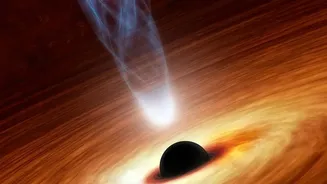
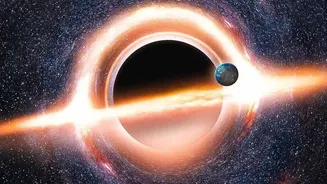
In a discovery decades in the making, an international team of scientists has confirmed the existence of a 'microblazar' within the Milky Way. Named IRAS 18293-0941, this system consists of a black hole about 10 times the mass of our sun locked in a tight
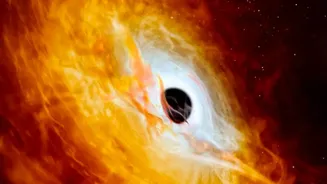
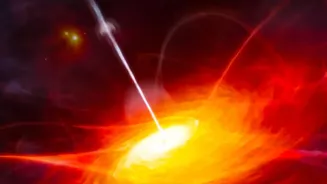
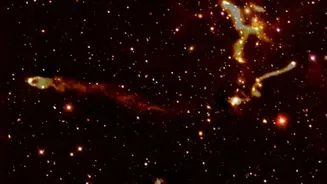
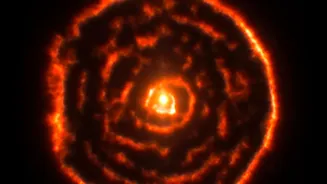
orbital dance with a massive companion star. As the black hole's immense gravity siphons material from the star, it doesn't just swallow everything. Instead, it forms a swirling, superheated structure called an accretion disk, which acts as the engine for two powerful jets of plasma. One of these jets is fired out at an astonishing 75% of the speed of light, or roughly 225,000 kilometres per second. What makes this discovery so significant is that this particular jet is pointed almost directly at Earth.
What is a Microblazar?
Think of it as a miniature version of a blazar. Blazars are powered by supermassive black holes, millions or billions of times the mass of our sun, that sit at the centres of distant galaxies. Their jets are among the largest and most energetic structures in the universe. A microblazar, by contrast, involves a much smaller, stellar-mass black hole feeding on a companion star. When one of its jets happens to be aimed in our direction, an effect called relativistic beaming makes it appear exceptionally bright. This cosmic alignment gives astronomers a unique opportunity to study the physics of these extreme objects up close—in this case, from a relatively safe distance of 12,000 light-years.
How a Cosmic Speed Gun Works
Finding and confirming IRAS 18293-0941 was a masterclass in cosmic detective work. The object was first catalogued in the 1980s but was obscured by thick clouds of interstellar dust. For years, it remained a mysterious source of infrared light. By combining data from multiple observatories across the globe—including radio telescopes in South Africa and high-resolution satellite positioning—astronomers pieced the story together. They confirmed that the one-sided jet they detected was not from a distant galaxy but was indeed linked to the star system. They could even see the effects of the second, opposing jet, which is not pointed towards us. This second jet is carving out a massive bubble in a nearby gas cloud, causing the gas to glow where it collides. This multi-faceted approach allowed the team to confirm the system's nature and measure the jet's incredible velocity.
Why This Discovery Matters
Beyond the sheer speed, this microblazar provides a vital, local laboratory for studying some of the universe's biggest questions. These jets are powerful enough to influence their surroundings, pumping huge amounts of energy and matter into space. This process can affect how stars form and how galaxies evolve over millions of years. Furthermore, these jets are considered prime candidates for accelerating cosmic rays—highly energetic particles that constantly bombard Earth from space. By studying the interaction between the jet from IRAS 18293-0941 and the surrounding gas cloud, scientists hope to better understand how these natural particle accelerators work. It's a chance to witness, in detail, the transfer of energy from a black hole back into its galactic environment.