






What the Landmark Pact Entails
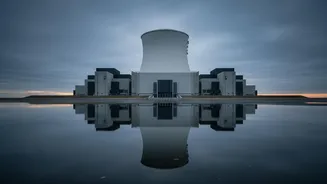
The agreement, signed by US and Saudi energy officials, is a 30-year pact designed to help Saudi Arabia build its first nuclear power plants using American technology. For Riyadh, this is a key part of its economic diversification plan, allowing it to generate
electricity from nuclear power and export more of its valuable oil reserves. For the United States, the deal represents a major commercial opportunity for its nuclear industry and a strategic move to keep competitors like China and Russia from gaining a foothold in the Saudi nuclear sector. At its core, the pact is about energy and economics, but it is deeply entangled with the complex geopolitics of the Middle East.
The Geopolitical Chessboard
This nuclear agreement wasn't conceived in a vacuum. It was originally part of a much larger, three-way 'mega-deal' envisioned by Washington. The framework involved the U.S. providing Saudi Arabia with a civilian nuclear program and security guarantees in exchange for Riyadh formally normalizing diplomatic relations with Israel. This grand bargain was seen as a way to reshape the Middle East, create a powerful regional bloc to counter Iran, and score a major foreign policy win. However, the current deal has been decoupled from the condition of Israeli normalization, a move that has changed the political calculus and alarmed many original supporters of the initiative. While the White House has since suggested the deal is still subject to Saudi Arabia joining the Abraham Accords, the path forward remains unclear.
Deep Divisions in Washington
The deal's arrival in Washington has been met with significant resistance, particularly from Democratic lawmakers. A primary concern is nuclear proliferation. Critics fear that allowing Saudi Arabia to develop nuclear infrastructure, potentially including uranium enrichment capabilities, could set a dangerous precedent. They warn it might trigger a regional arms race, with other countries like Egypt and Turkey possibly seeking similar technology. There is also deep-seated mistrust of the Saudi government, with many lawmakers pointing to the kingdom's human rights record and Crown Prince Mohammed bin Salman's previous statement that Saudi Arabia would pursue a nuclear weapon if Iran developed one. Some critics, like Representative Brad Sherman, have compared providing this technology to arming the Shah of Iran before the 1979 revolution, a move that backfired on the U.S.
The Missing 'Gold Standard'
A major point of contention is that the agreement reportedly does not hold Saudi Arabia to the so-called "gold standard" of nonproliferation. This standard was part of a similar US deal with the United Arab Emirates in 2009, in which the UAE agreed to forgo uranium enrichment and reprocessing on its own soil. Furthermore, the current Saudi deal does not appear to require Riyadh to sign the International Atomic Energy Agency's (IAEA) "Additional Protocol," which allows for more intrusive and comprehensive inspections to ensure a nuclear program remains peaceful. This perceived lack of robust safeguards is a red line for many in Congress, who see it as weakening the global nonproliferation regime.
An Uphill Battle for Approval
The path forward for the pact is steep. Under US law, Congress has the power to review and potentially block such nuclear cooperation agreements. While it would require a veto-proof two-thirds majority in both the House and Senate to completely stop the deal, the political opposition is significant and crosses party lines to some extent. Lawmakers are set to scrutinize every detail of the agreement, questioning whether the strategic benefits of partnering with Riyadh outweigh the long-term risks of nuclear proliferation in one of the world's most volatile regions. The debate will force a difficult conversation about America's role in the Middle East and the price of maintaining influence.