






What Exactly Is a 'Fire Rainbow'?
First things first: the term 'fire rainbow' is a bit of a misnomer. The phenomenon has nothing to do with fire, and it isn't a rainbow in the traditional sense, which is formed by the refraction and reflection of light in water droplets. The scientifically
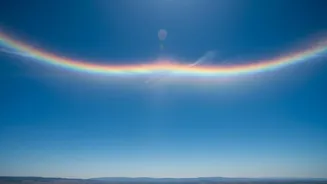
accurate name is a circumhorizontal arc. The dramatic nickname likely comes from its appearance, which can look like a bright, flame-like splash of colour hanging parallel to the horizon. Unlike a typical rainbow that arches across the sky after rain, a circumhorizontal arc is an ice halo, created by light interacting with ice crystals suspended high in the atmosphere.
The Science: Sun, Ice, and Perfect Alignment
For this beautiful spectacle to occur, a very specific set of ingredients must come together perfectly. It all starts with the right kind of clouds: thin, wispy cirrus clouds floating at high altitudes, typically above 6,000 metres. At this height, the temperature is so low that these clouds are not made of water droplets but of millions of tiny, plate-shaped hexagonal ice crystals. For a circumhorizontal arc to form, these plate-like crystals must be oriented horizontally, like tiny floating dinner plates. Sunlight enters through a vertical side face of the crystal and exits through the bottom horizontal face. This 90-degree bending of light acts like a prism, splitting the sunlight into its component colours and creating the vibrant spectrum we see.
The Sun's Angle Is Everything
The most crucial factor, and the one that makes this phenomenon so rare, is the position of the sun. A circumhorizontal arc can only be seen when the sun is very high in the sky—at an elevation of at least 58 degrees above the horizon. If the sun is any lower than this, the light won't hit the ice crystals at the correct angle to produce the effect. This specific requirement means that the phenomenon is impossible to see at latitudes above 55 degrees, as the sun never gets that high in the sky. For those in mid-latitude regions like India, the best chance to see one is during the summer months around midday, when the sun is at its highest point.
Your Checklist for Spotting One
So, how can you increase your chances of seeing a circumhorizontal arc? It’s all about knowing what to look for and when. First, pay attention to the time of day and year. Your best bet is during the summer months, within a few hours of solar noon when the sun is at its peak elevation. Second, look for the right clouds. You’ll need to spot thin, wispy cirrus clouds; the phenomenon won’t happen in thick, puffy cumulus clouds. Sometimes, the arc may appear fragmented if the cloud cover is patchy. Finally, know where to look. The arc appears parallel to the horizon and well below the sun, so you’ll need to scan the sky at the right elevation. Wearing polarised sunglasses can also help make a faint arc more visible. It’s a game of patience and luck, but with the right conditions, you might just witness one of nature's most dazzling optical illusions.