




The Gurugram Gauntlet
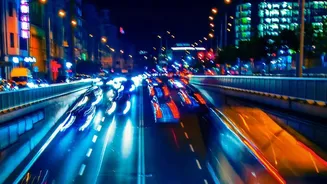
The on-screen display, designed to show what the car’s AI “sees,” becomes a frantic digital ballet. Boxes of varying sizes flicker, representing cars, auto-rickshaws, motorcycles, and pedestrians, all jostling for the same sliver of asphalt. In Gurugram,
lanes are often treated as suggestions, and traffic is a fluid negotiation involving honks, hand gestures, and intuition. Into this environment comes Tesla's software, an intelligence trained predominantly on the orderly, well-marked roads of North America and Europe. The visualization reveals the AI's struggle: it diligently attempts to label and predict the movement of every object, from a vendor pushing a cart to a cow meandering by the roadside—elements that are extreme edge cases in the West but daily realities here.
What the AI Is Trying to Do
Tesla's Full Self-Driving (FSD) Beta is one of the most ambitious consumer AI projects ever deployed. Using a suite of eight cameras, it creates a 360-degree view of the world around it. This visual data is fed into a powerful neural network that identifies objects, understands their relationships, and predicts their future paths to navigate the vehicle. The on-screen map is a real-time digital twin of this perceived reality. It’s meant to build driver trust by showing that the car sees the same world they do. In a controlled environment, it’s a clean, confidence-inspiring interface. But on a busy Gurugram road, it highlights the sheer complexity and computational challenge of interpreting a traffic environment that defies simple rules.
Code Meets Unpredictable Chaos
The primary challenge for any autonomous system in India is not the density of traffic but its heterogeneity and unpredictability. An AI can be trained on millions of miles of highway driving, but that data is of limited use when an auto-rickshaw makes a sudden, unsignalled turn or a group of pedestrians decides to cross against the light. These are not just “edge cases”; they are the norm. The system, which relies heavily on clear lane markings and predictable driver behaviour, finds itself in an environment where neither exists consistently. While recent videos show the system is surprisingly adept at identifying many of the unique elements of Indian traffic, actually navigating through them is another matter entirely. The constant need for the AI to re-evaluate and re-classify objects in this fluid environment pushes the system to its limits.
The 'India Problem' Is a Global AI Challenge
The difficulties faced by Tesla in Gurugram are not unique to the company; they represent a fundamental challenge for the entire autonomous vehicle industry. India is often cited as the ultimate testing ground for self-driving technology. If an AI can safely navigate the streets of Delhi, Mumbai, or Gurugram, it can likely drive anywhere. This requires a shift from rules-based systems to something more akin to human intuition—an AI that understands the local driving culture and unwritten social contracts of the road. This is why many experts believe that autonomous vehicles in India will require India-specific datasets and extensive local training to become viable and safe. Western systems simply aren't built for this level of improvisation.
A Reality Check for the Hype
While Tesla has not officially launched FSD in India due to regulatory hurdles, these real-world demonstrations are invaluable. They serve as a powerful reality check on the marketing hype surrounding self-driving cars. The technology is not a magical, one-size-fits-all solution. It is a learning system, and the Gurugram test is a stark lesson in humility. It demonstrates both the impressive power of modern AI to perceive a complex world and its profound limitations in navigating it without a human-like understanding of context. For Tesla, this is not a failure but a crucial data-gathering exercise. For the rest of us, it's a reminder that the road to a fully autonomous future, especially in India, will be a long and winding one, full of potholes, pedestrians, and unexpected turns.