



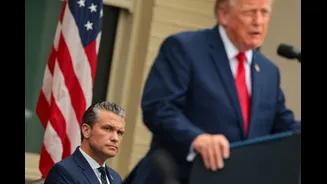
The 2026 midterm elections are over, and Washington is now a city of divided government. With Democrats controlling Congress, President Trump's most powerful tool to counter their agenda might just be a pen—or rather, the refusal to use it.
What Is a Presidential Veto?
A presidential
veto is one of the most significant powers granted to the US president by the Constitution. Found in Article I, Section 7, it allows the president to reject a bill passed by both the House of Representatives and the Senate, preventing it from becoming law. This power serves as a crucial check on the legislative branch, ensuring the president has a say in the laws that govern the country. There are two main types of vetoes: the 'regular' veto and the 'pocket' veto. With a regular veto, the president sends the unsigned bill back to the chamber where it originated, usually with a written message explaining the objections. If the president simply refuses to sign a bill within 10 days (excluding Sundays) while Congress is in session, it automatically becomes law without his signature.
The Pocket Veto Explained
The pocket veto is a more absolute power, but it can only be used in a specific circumstance. If Congress passes a bill and then adjourns before the 10-day signing period is over, the president can simply do nothing and let the bill expire. This is known as a pocket veto because the president has effectively put the bill in a 'pocket' to die. Unlike a regular veto, a pocket veto cannot be overridden by Congress, making it a final say on the legislation for that session. Lawmakers would have to reintroduce the bill in the next congressional session and start the entire legislative process over again. The last president to use a pocket veto was Bill Clinton in 2000.
Can Congress Fight Back?
A presidential veto is powerful, but not absolute. Congress has the ability to override a regular veto, though it is a difficult task. To do so, the bill must be passed again by a two-thirds majority in both the House and the Senate. This high threshold means a veto override requires significant bipartisan support. If all members are present, that would mean securing 290 votes in the House and 67 in the Senate. Historically, this is rare; Congress has successfully overridden just over 4% of all presidential vetoes. During his first term, President Trump issued ten vetoes, and only one—a defense spending bill in 2020—was overridden by Congress.
Vetoes in a Divided Government
The power of the veto becomes magnified during periods of divided government, which is the exact scenario facing Washington after the 2026 midterms. When the president's party does not control both chambers of Congress, legislation passed by the opposition is more likely to face a presidential rejection. Since 1981, 98% of presidential vetoes have been issued under divided governments. The veto allows the president to block the majority party's legislative priorities, forcing compromise or creating gridlock. President Trump himself has signaled a willingness to use this power, recently telling an interviewer, 'I guess I'll become Mr. Veto'. He suggested he might veto legislation for a period before starting negotiations with Democratic leaders.
The Veto as a Bargaining Chip
Perhaps more powerful than the veto itself is the threat of a veto. Knowing that a bill is likely to be rejected can force Congress to negotiate with the White House long before a final vote is taken. This gives the president influence over the details of legislation, as lawmakers may be willing to amend a bill to make it more palatable to the president and avoid a veto that is difficult to override. This dynamic often leads to intense bargaining, where the president might agree to sign one bill in exchange for concessions on another. The coming years will likely see this strategic game play out frequently, as the Democratic-controlled Congress tests the limits of what it can pass against a president determined to hold his ground.