



Raj Bhavan (Government House)
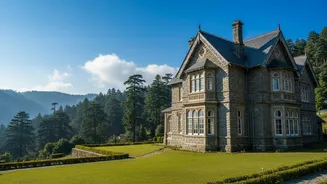
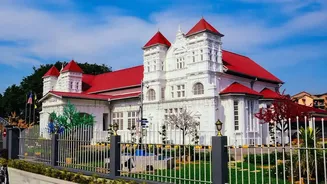
A magnificent symbol of British authority, the Raj Bhavan was constructed between 1897 and 1900 to serve as the summer residence of the Governor. Designed by architect F.W. Stevens in a Victorian Gothic style, its resemblance to a Scottish castle, complete
with turrets and spires, was intentional. Spread across 205 acres, the estate includes a vintage golf course. The structure, built with dark grey marl stone, was meant to project an image of permanence and power in the hills. After independence, it became the official residence for the Governor of Uttarakhand, with Sarojini Naidu being the first Indian governor to occupy it.
St. John in the Wilderness Church
One of the earliest structures in Nainital, this church's foundation was laid in 1844. It got its evocative name when the Bishop of Calcutta, Daniel Wilson, fell ill and had to stay in an unfinished hut in the forest while visiting to consecrate the church. Built in the Neo-Gothic style, it is nestled amidst a dense deodar forest, creating a serene and timeless atmosphere. Inside, a brass plaque commemorates the residents who tragically lost their lives in the devastating landslide of 1880, forever linking the church to one of the most significant events in the town's history.
Gurney House
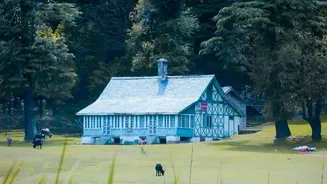
This charming cottage on Ayarpatta Hill was the home of the legendary hunter-conservationist and author, Jim Corbett. Built in 1881, the house was constructed using materials salvaged from the Corbetts' previous home on Alma Hill, which had been damaged in a landslide. Corbett and his sister Maggie lived here until they departed for Kenya in 1947. Today, it remains a private residence but is a site of pilgrimage for Corbett enthusiasts, as it still contains many of his personal belongings, furniture, and trophies, offering a tangible connection to the man and his era.
Sherwood College
Established in 1869, Sherwood College is one of India's most distinguished boarding schools and a cornerstone of Nainital's identity as a centre for elite education during the Raj. Initially founded as the Diocesan Boys' School, it was intended to educate the sons of British officials and the Indian aristocracy. The sprawling 45-acre campus on Ayarpatta Hill reflects classic colonial school architecture. Its endurance through two World Wars and the transition to a free India speaks to its foundational role in the town's development.
Balrampur House
Originally the summer palace for the royal family of Balrampur, this property showcases how Indian royalty also adopted Nainital as a seasonal retreat. While the original structure dated to the 1880s, it was completely redesigned in the 1930s by a European architect in the style of a French chateau. The blend of European architectural fantasy with the needs of an Indian princely state makes it a unique landmark. Now a heritage hotel, its expansive gardens and period furniture offer visitors a glimpse into the opulent lifestyle of the maharajas during the colonial era.
Nainital Yacht Club
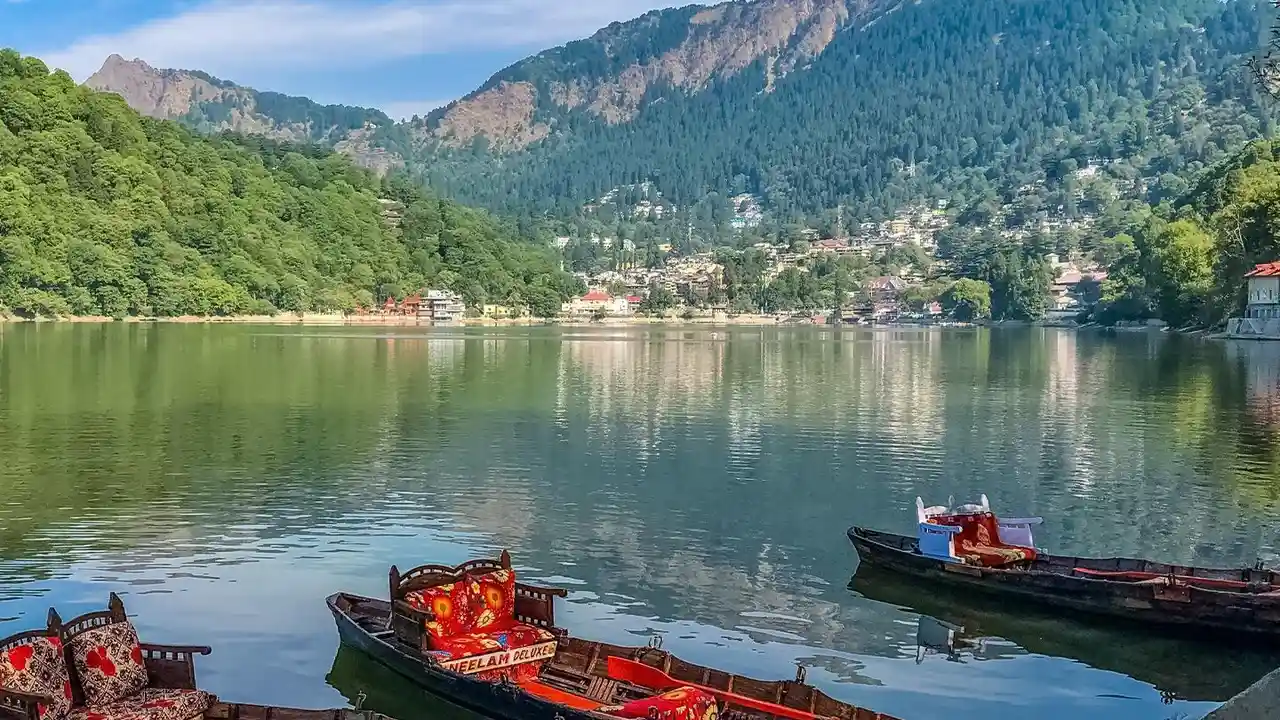
Yachting on the Naini Lake began as early as 1880, but the Nainital Yacht Club (NTYC) was officially formed in 1910 by the Carey brothers, two British officers. As one of the highest yacht clubs in the world, it was an exclusive hub of social activity for the colonial elite. The club used a special class of yachts, the “Linton Hope Half-Raters,” specifically designed for the lake's unique wind conditions. After 1947, the club was taken over by Indian members and continues to operate today as the Boat House Club, a living legacy of the recreational pursuits of the summer capital.
Metropole Hotel
Once considered the finest hotel in Nainital, the Metropole was built in 1880. It was renowned for its unique 'Nainital-pattern-roofing' using galvanised tin plates, a design that was replicated across the country. The hotel played host to many famous personalities, including Mohammad Ali Jinnah, who spent his honeymoon there in 1918. Owned by the Raja of Mahmudabad, it was declared an 'enemy property' after he moved to Pakistan following the partition, which led to its gradual decline. Though now defunct and repurposed, its story reflects the complex transitions of the post-colonial era.