



Solving a Galactic Mystery
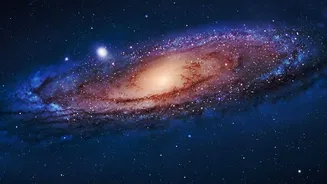
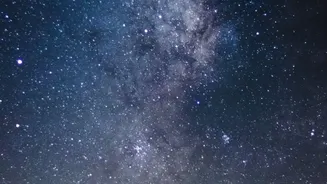
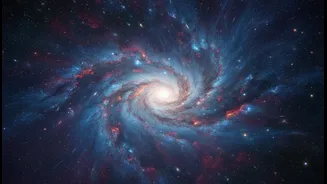
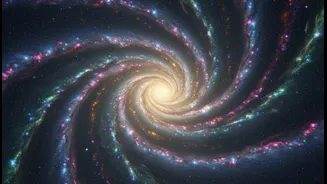
The clue that led to this stunning discovery was a long-standing puzzle surrounding our galaxy's stellar halo. Most of the Milky Way’s hundred billion stars, including our Sun, are packed into a flat, rotating spiral disk, spinning at around 220 kilometres
per second. Surrounding this is the halo, a vast, sparse cloud of ancient stars. Observations from the European Space Agency’s Gaia mission revealed something strange: the stars in this halo rotate incredibly slowly, at only about 25 kilometres per second. This discrepancy has puzzled astronomers for years, suggesting a dramatic event in our galaxy's history was waiting to be uncovered.
The Prime Suspect: A Cosmic Collision
To understand why the halo stars were moving so sluggishly, researchers at Durham University turned to powerful supercomputer simulations. They modelled the evolution of galaxies similar to our own over billions of years. The simulations showed a consistent pattern: galaxies with slow-moving stellar haloes almost always had two things in common. They had experienced a massive, head-on collision with another galaxy, and their entire disk had undergone a “flip,” tilting by more than 90 degrees. Astronomers already knew the Milky Way had a major collision in its past with a dwarf galaxy known as Gaia-Sausage-Enceladus. This event, which happened around 10 to 11 billion years ago, is considered the last major merger in our galaxy's history.
The 'Sausage' and the Somersault
The Gaia-Sausage galaxy got its unusual name after data from the Gaia mission in 2018 revealed a group of stars moving in radical, sausage-shaped orbits. These were the remnants of a dwarf galaxy that ploughed straight into the young Milky Way, which then tore the intruder apart and absorbed its stars. Though classified as a dwarf galaxy, Gaia-Sausage was immense, containing stars, gas, and dark matter with a mass over 10 billion times that of our Sun. The new research suggests this head-on impact was so cataclysmic that it unleashed enough chaos to slowly reorient the entire Milky Way disc, a process that likely took hundreds of millions of years.
A New Chapter in Our Galactic Story
This discovery fundamentally rewrites our understanding of the Milky Way’s evolution. It suggests that our galaxy is not a static structure but a dynamic entity shaped by violent encounters. The collision with Gaia-Sausage didn't just add stars to the halo; it physically tilted the entire galaxy. According to lead researcher Kirill Batrakov, this means that most of the Milky Way's stars, possibly even our own Sun, once travelled on very different paths than they do today. Our supposedly stable spot in the cosmos may not have been so stable throughout the Solar System's entire lifetime. The findings were presented at the Royal Astronomical Society's National Astronomy Meeting, adding a dramatic new chapter to the story of how our galaxy came to be.