



Meet the Giants: Hellas and Argyre
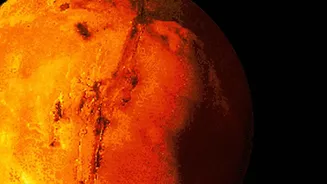
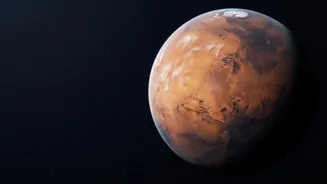
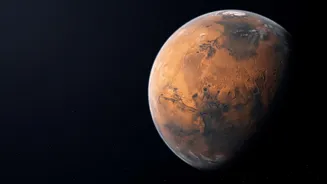
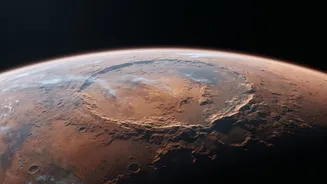
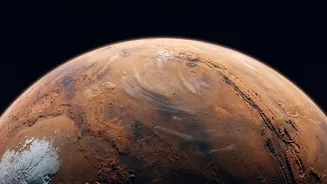
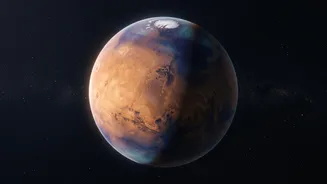
On a planet covered in craters, Hellas and Argyre stand out. They are not just craters; they are colossal impact basins in Mars's southern hemisphere. Hellas Planitia is one of the largest and deepest depressions on the entire planet, stretching about
2,300 kilometers across. Its floor sits several kilometers below the surrounding terrain, creating a pocket of higher atmospheric pressure. Argyre is smaller but still massive, a well-preserved basin surrounded by ancient, rugged highlands. Their immense size and unique topography are what make them so scientifically valuable. These basins act like giant bowls, influencing atmospheric circulation and creating localized weather phenomena that can tell us a great deal about the planet as a whole.
Decoding Mars's Wild Weather
Researchers at the Physical Research Laboratory (PRL) in Ahmedabad have been analysing data to map the extreme temperature fluctuations on Mars. The planet's thin atmosphere means it cannot hold onto heat effectively, leading to dramatic swings. Temperatures can plummet to around -123°C and rise to a relatively balmy 22°C in the same region. The scientists are particularly interested in large-scale atmospheric patterns known as 'zonal waves'. Think of them as ripples in the atmosphere that move heat and energy around the planet. By studying these waves, scientists get an indirect look at how the entire Martian atmosphere circulates, much like watching ripples on a pond to understand the currents beneath.
A Unique View from Orbit
This groundbreaking research from PRL scientists utilizes data from the Emirates Mars Mission's Hope spacecraft. The team analyzed observations from the Emirates Mars Infrared Spectrometer (EMIRS), which measures thermal radiation from the planet's surface to create detailed temperature maps. This work builds on a legacy of Martian observation by Indian science, including instruments on India's own Mars Orbiter Mission (MOM). Instruments like MOM’s Thermal Infrared Imaging Spectrometer (TIS) and Mars Colour Camera (MCC) were designed to study the planet's surface temperature, mineralogy, and atmospheric events like dust storms, contributing to the global effort to understand the Red Planet.
Natural Laboratories for Planetary Science
The contrast between the two basins proved striking. The study found that the Argyre basin was dominated by a simple, large-scale wave pattern (wave-1), while the much deeper Hellas basin showed more complex wave-2 and wave-3 patterns that changed with the seasons. This suggests that the profound depth and unique geography of these basins directly shape and amplify the temperature patterns. The extreme differences in elevation create distinct atmospheric conditions that make these basins perfect test cases. By comparing them, scientists can better understand how topography drives weather on a planetary scale, refining climate models that have often struggled to match real-world observations.
Paving the Way for Future Missions
Understanding Mars's weather isn't just an academic exercise. This knowledge is critical for the future of robotic and human exploration. Extreme temperature swings and unpredictable atmospheric behaviour pose significant risks for landing spacecraft, operating surface rovers, and designing habitats for future astronauts. Detailed weather maps and a better grasp of atmospheric dynamics, driven by studies like this one from Indian researchers, will be essential for selecting safe landing sites and ensuring the success of complex surface operations on the Red Planet. Every insight into Mars's climate brings us one step closer to setting foot there safely.