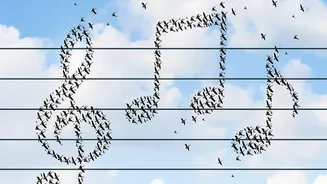









An Avian Alphabet
Imagine being able to distill every language on Earth into a handful of core sounds. That's essentially what a team of scientists has done for the world of passerine birds, a massive group that includes over 60% of all bird species. In a study published
in the journal Science, researchers analyzed a staggering 116,000 songs from over 3,100 species. Using machine learning to parse this enormous dataset, they made a profound discovery: the spectacular diversity of birdsong is constructed from just eight basic acoustic building blocks, or “motifs.” This finding suggests that a hidden acoustic grammar unites the songs of thousands of species across the globe.
The Eight Building Blocks
So, what does this universal birdsong toolkit sound like? The eight motifs identified by the researchers cover the full range of avian vocal production. They include three types of whistles (flat, slow-modulated, and fast-modulated) and three types of trills (slow, fast, and ultrafast). The remaining two components are more complex: “harmonic stacks,” which are multiple frequencies sounding at once, and atonal “chaotic notes.” For example, the familiar, plaintive “pee-ah-wee” of the Eastern Wood-Pewee is a classic slow-modulated whistle. In contrast, a Bohemian Waxwing’s call is a prime example of an ultrafast trill, with rapid-fire notes that blur together. While most species have about five of these motifs in their repertoire, nearly two-thirds of all songs are complex vocalizations that mix multiple motifs together.
Listening with a Digital Ear
This discovery would have been impossible without the help of artificial intelligence and a vast trove of community science data. Researchers led by Quentin Bacquelé of Saint-Étienne University in France leveraged recordings from online databases like iNaturalist and xeno-canto, where birders upload their findings. Instead of just measuring simple features like pitch, the team used a new machine learning approach to analyze the detailed patterns of sound across both time and frequency. This allowed them to compare songs on an unprecedented global scale, revealing the common patterns that had been hidden in plain sight—or rather, plain sound.
Why Simplicity Matters
The study didn’t just identify the building blocks; it also explored why birds choose certain sounds. The researchers found a fascinating trade-off between communication distance and information complexity. Birds living in dense forests, where sound gets distorted, tend to use simpler songs with clear, flat whistles that travel farther. Conversely, birds in more open temperate regions often use faster, more complex trills that carry a lot of information but degrade over shorter distances. This suggests that a bird’s song is finely tuned by its environment. However, the single biggest factor determining a bird's song is its evolutionary history, which accounted for 82% of the variation in the motifs used.
The Future of Eavesdropping
This new framework for understanding birdsong opens up exciting possibilities. By establishing a universal dictionary of song components, scientists can now study animal communication on a global scale, looking for deeper patterns in how and why species communicate. The approach could be applied to other vocal animals, from frogs to insects to marine mammals. Furthermore, understanding the link between habitat and song structure could be a vital tool for conservation. As human activity like deforestation and urban noise alters natural soundscapes, this research can help us monitor how bird populations are adapting—or failing to adapt—to a changing world.