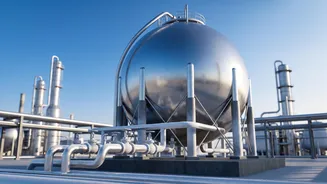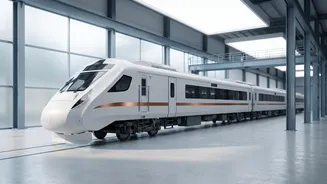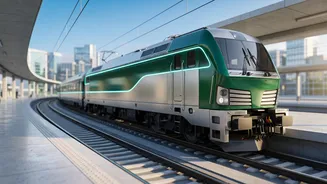





Indian Railways has marked a major milestone with the rollout of its first train powered by Liquefied Natural Gas (LNG) from Sabarmati, Gujarat. This pioneering move signals a significant step towards cleaner, more sustainable public transport.
How the Dual-Fuel System Works
This isn't
a train that runs purely on LNG. Instead, it employs a clever dual-fuel system. Two 1,400-horsepower Driving Power Cars (DPCs) on a DEMU train have been retrofitted to run on a mixture of diesel and LNG. The technology allows the engine to substitute up to 40% of its conventional diesel consumption with the cleaner-burning natural gas. This provides crucial operational flexibility; the engine can seamlessly switch between the two fuels depending on availability and need, without any loss in performance. Before its formal launch on September 27, 2026, the train successfully completed over 2,000 kilometres of rigorous field trials to ensure its reliability and safety.
The Green and Economic Benefits
The primary driver behind this innovation is twofold: cutting costs and curbing pollution. LNG burns much cleaner than diesel, leading to a significant reduction in harmful emissions like carbon dioxide, nitrogen oxides (NOx), and particulate matter. This contributes directly to better air quality along some of the country's busiest rail corridors. Economically, the benefits are just as compelling. Based on trial data, Indian Railways estimates that using LNG could save approximately ₹11.9 lakh annually for a single Driving Power Car. For an entire eight-coach train, the projected savings climb to around ₹23.9 lakh per year. These savings can be reinvested into further modernizing the rail network.
LNG vs. Hydrogen: A Tale of Two Technologies
This LNG train launch comes just two months after Indian Railways introduced its first hydrogen-powered train in July 2026. While both are green initiatives, they represent different technological paths. The hydrogen train uses a fuel cell to generate electricity from hydrogen and oxygen, with water vapour as its only direct emission. The LNG train, on the other hand, adapts the existing internal combustion engine to use a cleaner fuel alongside diesel. Think of LNG as a practical, immediate step to reduce emissions on existing infrastructure, while hydrogen represents a more fundamental, long-term shift towards zero-emission propulsion.
The Journey Ahead for Greener Railways
The inaugural journey of the eight-coach, non-AC chair car train ran from Sabarmati to Mahesana Junction. While a regular commercial route is yet to be finalised, the launch itself is a powerful statement of intent. This LNG train serves as a crucial bridge technology, helping to decarbonise routes where full electrification is not yet feasible or economical. It complements the broader national strategy of electrifying high-density networks and exploring next-generation solutions like hydrogen. With plans to expand LNG conversions to more trains following approvals, this first journey from Sabarmati is not just a single trip, but the start of a new, cleaner chapter for India's iconic railways.