





A Star's Violent Demise
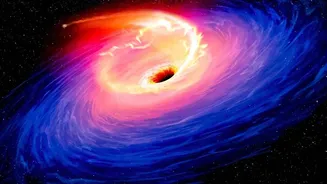
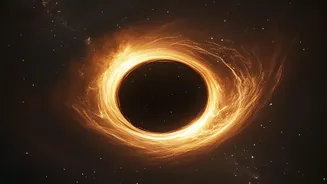
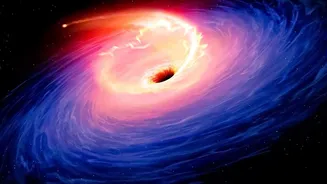
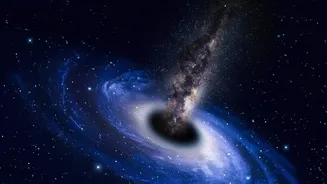
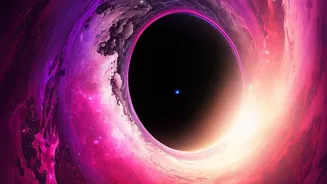
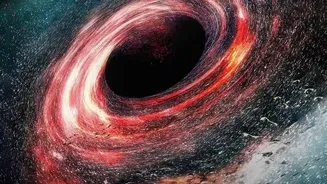
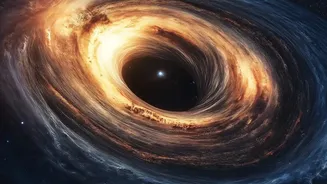
Out in the vastness of space, when a star wanders too close to a supermassive black hole, the outcome is catastrophically one-sided. The black hole's immense gravitational pull exerts extreme tidal forces that stretch and tear the star apart in a process
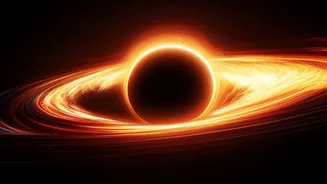
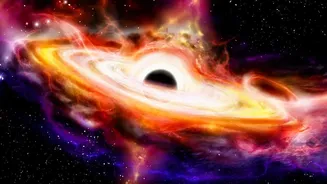
fittingly called 'spaghettification'. This cosmic homicide is known as a Tidal Disruption Event, or TDE. As the stellar material is shredded, it forms a superheated disc of gas and dust that swirls around the black hole before being consumed. This process releases an enormous flare of energy, a brief but brilliant flash of light across the spectrum that can outshine all the billions of stars in its host galaxy combined. For astronomers, these TDEs are invaluable, acting as a bright beacon that temporarily illuminates an otherwise dormant and invisible black hole.
How a Cosmic Crime Scene Was Spotted
The initial alert for this unusual event came in late 2025 from the Zwicky Transient Facility (ZTF) at the Palomar Observatory in California. The ZTF scans the entire northern sky every two days, hunting for transient events—things that flare up and fade away. An advanced AI algorithm, designed to sift through half a million cosmic flashes detected nightly, flagged a flare that had all the hallmarks of a TDE but was in a very strange location: the outskirts of a galaxy 750 million light-years away. This triggered follow-up observations from other telescopes, including NASA's Neil Gehrels Swift Observatory. Swift, a space telescope designed to rapidly respond to high-energy events like gamma-ray bursts, was able to study the flare in ultraviolet light, confirming its nature as a TDE and helping to measure its extreme temperature.
The Mystery of the Off-Centre Black Hole
What makes this discovery so compelling is its location. The universe is generally a well-ordered place, and one of its fundamental rules is that supermassive black holes—the million-to-billion-solar-mass giants—reside at the very centre of large galaxies like our own Milky Way. They are the gravitational anchors around which everything else revolves. Finding a TDE, and therefore a supermassive black hole, tens of thousands of light-years away from the galactic core is like finding a city's main railway station in a distant suburb. It defies the standard model of where these cosmic titans are supposed to live and hunt. This observation is one of the first confirmed instances of a supermassive black hole feasting on a star so far from the galactic centre.
Searching for Wandering Giants
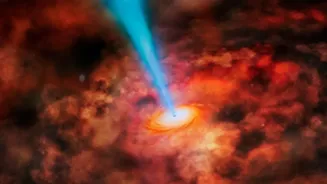
The most likely explanation for this cosmic anomaly is that astronomers have found a 'wandering' black hole. Such objects are thought to be the remnants of galactic mergers. When two galaxies collide and merge, their central supermassive black holes eventually spiral towards each other and combine. However, in the chaotic gravitational dance of this merger, it's possible for a smaller of the two black holes to be flung out into the galactic halo. These wandering black holes would roam their new, larger galaxy silently and invisibly, unless they happened to encounter and devour a star. This TDE acts as a cosmic flare, momentarily revealing the location of one of these hidden wanderers. The discovery validates a new technique for finding these otherwise invisible objects, opening a new window into studying the messy and dynamic history of galaxy formation.