






Meet the Sun Grazer
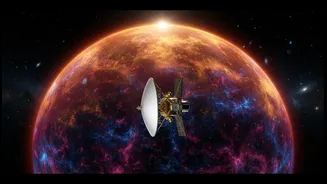
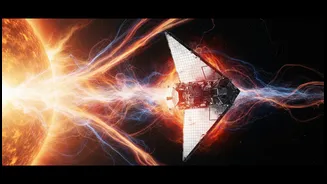
The intrepid explorer at the heart of this story is NASA’s Parker Solar Probe. Launched in 2018, its mission is nothing short of historic: to touch the Sun. By flying through the Sun's outer atmosphere, or corona, the probe is venturing into a region
no spacecraft has ever visited. To survive, it hides behind a revolutionary carbon-composite heat shield that endures temperatures hot enough to vaporise metal, while keeping its sensitive instruments at a comfortable room temperature. The probe has already broken records for both the closest-ever approach to the Sun and the fastest speed ever achieved by a human-made object. Its journey consists of a series of 24 progressively closer orbits, using gravity assists from Venus to draw its path nearer to our star with each pass.
What Is the Solar Wind?
Imagine a never-ending breeze flowing outward from the Sun in all directions. That’s the solar wind. It's not air, but a stream of plasma—superheated gas made of charged particles like protons and electrons—that escapes the Sun's corona where temperatures reach millions of degrees. This wind travels at incredible speeds, often around 400 kilometres per second, or about one million miles per hour. First theorised by physicist Eugene Parker in 1958, for whom the probe is named, the solar wind fills the entire solar system, creating a vast bubble called the heliosphere. It interacts with every planet, including Earth, where our magnetic field deflects most of it, but some particles get through to create the beautiful auroras.
The Mystery of Its Behaviour
For decades, scientists have studied the solar wind from near Earth's orbit, but that’s like studying a river far downstream from its source. How the wind is born and accelerated remains a key puzzle. We know there are two types: a fast wind and a slow wind, which appear to originate from different areas of the Sun. But why is the corona millions of degrees hotter than the surface below it, and how does this extreme heat drive the wind? Parker Solar Probe is tackling these questions by flying directly through the wind's birthplace. Data from its initial orbits has already revealed a surprisingly complex environment, full of strange magnetic kinks called 'switchbacks' and unexpected plasma jets. Scientists believe these structures hold clues to how the wind is heated and violently flung into space.
What the New Data Could Reveal
The term 'far from Earth' in this context means getting extraordinarily close to the Sun, into a region we have never directly sampled. With each orbit, Parker gets closer to the solar surface, and the data it sends back becomes more revolutionary. The probe's next datasets, gathered from its closest passes yet, are eagerly awaited. Scientists hope this information will finally pinpoint the exact mechanisms that accelerate the fast and slow solar winds and explain the mysterious heating of the corona. Recent discoveries from the probe have already introduced a new variable: charged dust near the Sun, which might play an unexpected role in how the corona gets so hot. The new data will allow scientists to test these emerging theories, offering a clearer picture of the forces that govern our star.
Why It Matters for India and the World
Understanding the solar wind is not just an academic exercise. This stream of particles drives 'space weather,' which can have significant effects on our technologically dependent society. Intense bursts of solar wind can disrupt satellites, jeopardise telecommunications, knock out power grids, and pose a radiation risk to astronauts. As nations like India continue to expand their satellite networks for communication, navigation, and earth observation, the ability to predict space weather becomes increasingly critical. By understanding the solar wind at its source, scientists can build better forecast models. The data from Parker Solar Probe provides the fundamental knowledge needed to help protect our vital infrastructure in space and on the ground, making this mission a crucial investment in our shared technological future.