





An Orbital Junkyard
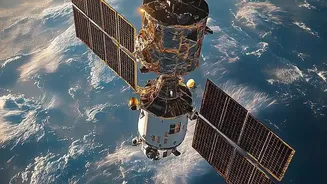
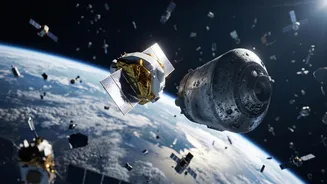
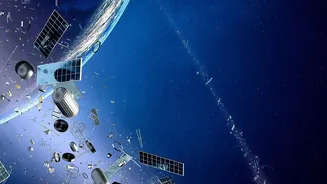
Low Earth Orbit (LEO) is getting dangerously crowded. For decades, every rocket launch and satellite deployment has left something behind, from spent rocket stages to defunct satellites and fragments from accidental collisions. There are now over 31,000
tracked objects—larger pieces of debris—circling the planet at incredible speeds of over 28,000 kilometres per hour. At that velocity, even a tiny, untrackable fleck of paint can inflict catastrophic damage on an operational satellite, threatening the GPS, communication, and weather forecasting services we rely on daily. The European Space Agency (ESA) recently reported that about ten new payloads are launched daily, while only three objects re-enter the atmosphere, creating a net gain of orbital clutter.
The Rising Risk of Collision
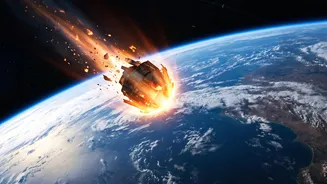
The primary concern is no longer just a single piece of debris hitting a single satellite. The real nightmare scenario, proposed by NASA scientist Donald Kessler in 1978, is known as the Kessler Syndrome. This theory describes a chain reaction where a collision creates a cloud of fragments, which in turn increases the probability of more collisions, creating even more debris. This could eventually render certain orbits completely unusable for generations. We’ve already had a preview: in 2009, a defunct Russian satellite collided with an active Iridium communications satellite, creating thousands of new pieces of trackable debris. With mega-constellations from companies like SpaceX adding thousands of new satellites, the orbital highways are becoming increasingly congested, making collision avoidance a constant challenge for operators.
The Emerging Cleanup Crew
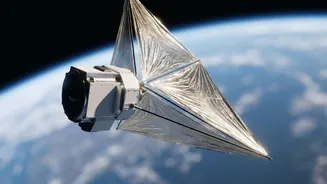
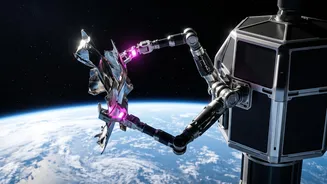
In response to this growing threat, a new industry is taking shape. The space debris removal market, which includes tracking and monitoring services, was valued at over $1.2 billion in 2025 and is projected to grow significantly. Several pioneering companies and agencies are developing technologies to actively remove the most dangerous objects. Japan's Astroscale has conducted successful demonstration missions, while the Swiss startup ClearSpace holds a contract with the ESA for the first-ever mission to remove a piece of debris, a leftover rocket adapter. Their methods sound like science fiction: robotic arms, harpoons, and giant nets designed to capture tumbling, non-cooperative targets. These missions are the first steps toward turning a global problem into a commercial service.
A Forecast, Not a Certainty
Despite promising growth forecasts, the business of space cleanup is fraught with uncertainty. The main question is: who pays? Today, missions are primarily funded by government agencies like ESA and JAXA as technology demonstrators. The cost is staggering, with a single removal mission priced at around $90 million. For a sustainable commercial market to exist, satellite operators, insurance companies, and governments will need to see a clear return on investment. Some analysts project the market could reach between $2 to $4 billion by the early 2030s, but this depends heavily on falling costs and the development of vehicles that can remove multiple objects per mission.
The Hurdles Ahead
Beyond the financial challenges lie significant legal and logistical roadblocks. A key issue is ownership; under international law, a defunct satellite still belongs to the country that launched it, meaning you can't just grab it without permission. Furthermore, an unsuccessful removal attempt could create even more debris, and determining liability for such an incident is a legal grey area. The technical difficulty cannot be overstated. Capturing a large object tumbling uncontrollably while travelling many times faster than a bullet is an immense robotic and engineering challenge. Without clear international regulations and a robust business model, the cleanup crew will struggle to get off the ground.