




A Galaxy Taking a Breather
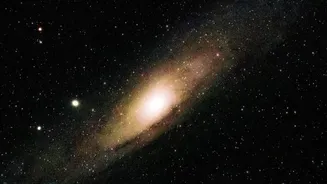
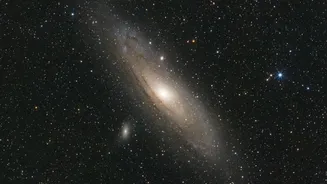
For centuries, the Andromeda galaxy has been a familiar, fuzzy patch in our night sky, a cosmic sibling to our own Milky Way. But recent studies reveal its life story is filled with booms and busts. Astronomers using the Hubble Space Telescope have found
that Andromeda's period of vigorous star birth is winding down. A new analysis shows that star formation in the galaxy has been steadily declining for the last 500 million years, with an even sharper drop in the most recent 40 million years. This discovery is like finding out a bustling city has been slowly quieting down over centuries. Previously, it was known that Andromeda had a massive burst of star creation about 2 billion years ago, possibly from merging with another galaxy. This new finding suggests the galaxy is now in a prolonged 'breather' phase after that intense activity.
Cosmic Forensics with Hubble
So how do you read the history of a galaxy 2.5 million light-years away? The answer lies in cosmic forensics. An international team of researchers combined data from two massive Hubble surveys, the Panchromatic Hubble Andromeda Treasury (PHAT) and its southern counterpart (PHAST). Together, these programs created an unprecedentedly detailed map of about two-thirds of Andromeda's disk, resolving roughly 200 million individual stars. As University of Washington astronomer Ben Williams explains, these stars are the "fossil record of the galaxy's formation." By analyzing the color and brightness of stars in different regions, scientists can determine their age. Massive, young stars burn hot and appear blue, while older, less massive stars are redder. By counting the types of stars in thousands of different sections, the team could rewind the clock and reconstruct a timeline of when and where the galaxy was most active.
The Fading of a Stellar Ring
The slowdown wasn't uniform across the entire galaxy. The study found that much of Andromeda's recent star-making has happened in a gigantic ring of gas and dust located about 32,000 light-years from the galactic center. This ring was once the galaxy's busiest stellar nursery, but its activity has been waning. As the engine of this primary star-forming region sputtered, it dragged the galaxy's overall production rate down with it. About 500 million years ago, Andromeda was creating stars at a rate of about one solar mass per year, similar to our Milky Way today. By 40 million years ago, that rate had halved. Today, it has plummeted to just one-fifth of a solar mass per year. This indicates a natural winding down, not a sudden stop.
A Galactic Suspect
There might be an accomplice in this story of cosmic quiet. Andromeda's small satellite galaxy, M32, is a prime suspect for influencing at least one quieter region. Astronomers have long theorized that M32 may have plunged through Andromeda's disk in the past. The new data shows that the part of Andromeda's disk closest to M32 began to slow its star formation about 60 million years ago, a potential clue to a past interaction. However, the timing doesn't perfectly match all theoretical models of M32's path, so while it's the "most likely suspect," as lead author Tobin Wainer noted, the case isn't closed. This finding highlights the complex gravitational dance that shapes galaxies over millions of years.