




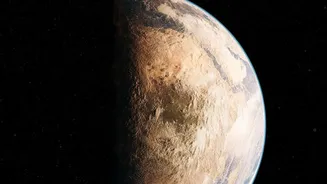
Meet the New Contender: LHS 1140 b
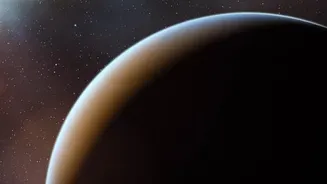
Located about 49 light-years away, LHS 1140 b has been an object of interest since its discovery in 2017. It's a 'super-Earth,' meaning it's a rocky world, but significantly larger and more massive than our own planet—about 1.7 times Earth's radius and 5.6
times its mass. It orbits its star within the 'habitable zone,' a region where conditions might be just right for liquid water to exist on the surface. Earlier studies with the James Webb Space Telescope had already suggested the planet was not a gas giant but a denser world, possibly even an ocean or ice planet. This made it a prime target for a closer look, but the latest finding has elevated its status from interesting to essential.
The Red Dwarf Problem
LHS 1140 b orbits a red dwarf star, the most common type of star in our galaxy. This might sound like good news, but red dwarfs are notoriously volatile. They are known for emitting powerful flares and intense high-energy radiation, especially in their youth. For a planet to stay warm enough in the habitable zone of a dim red dwarf, it must orbit very closely. This proximity exposes the planet to the star's most violent outbursts, which scientists have long believed would strip away any protective atmosphere. Many models predicted that rocky worlds around red dwarfs would be left as barren, airless rocks, making the discovery of a surviving atmosphere a genuine surprise.
How Scientists Found the Atmosphere
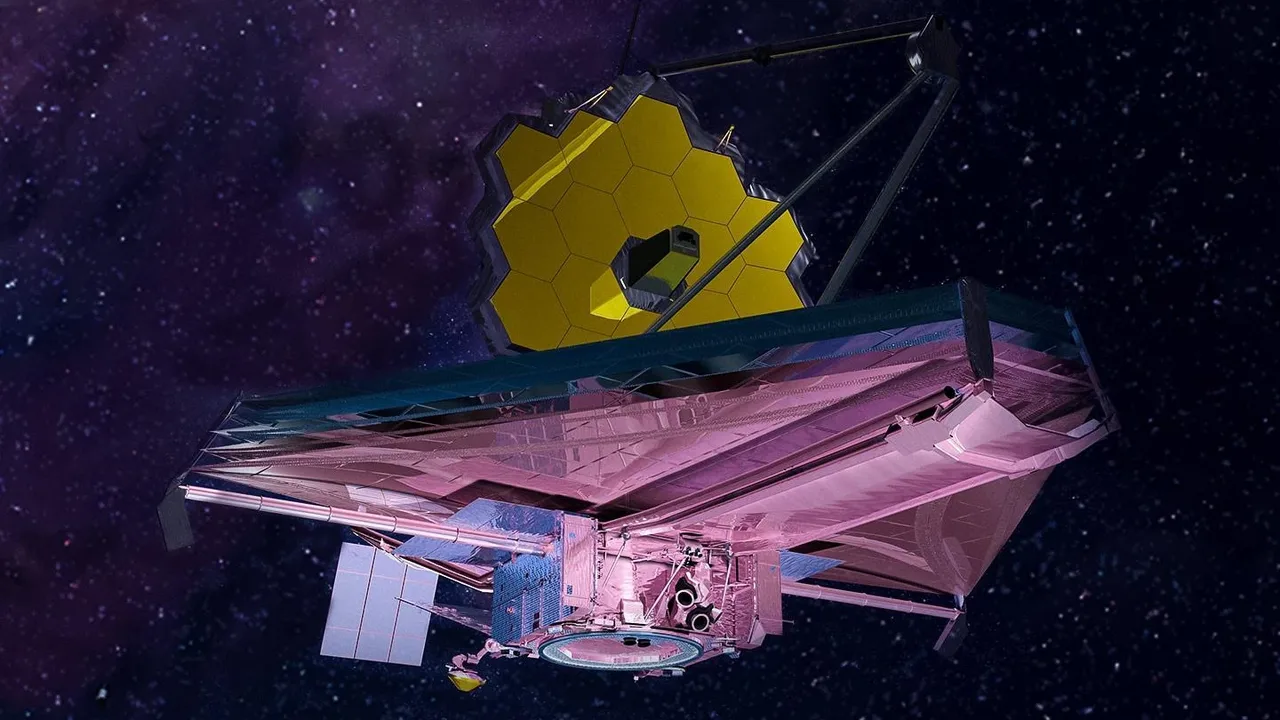
The breakthrough came not from seeing the atmosphere directly, but by detecting what was leaking from it. A team of researchers used the Magellan Clay telescope in Chile to observe the planet as it passed in front of its star. They were looking for the chemical signature of helium, a light gas that escapes from the top of an atmosphere into space. In 2024, they detected a clear signal of helium escaping from LHS 1140 b, providing the first strong proof that an atmosphere was present. According to lead author Collin Cherubim, a researcher from Harvard University, this is the first time an atmosphere has been observationally confirmed on a rocky planet in the habitable zone. The presence of helium acts as a definitive signpost, confirming that a much thicker, more substantial atmosphere lies beneath.
A Shield for a Potentially Watery World
An atmosphere is crucial for habitability. It provides a shield against harmful radiation, regulates surface temperature, and creates the pressure needed for liquid water to remain stable. Without it, any water would either freeze or boil away into space. Previous observations have suggested that LHS 1140 b could be a water world, with water making up a significant portion of its mass. The confirmation of an atmosphere makes this scenario much more plausible. The planet appears to have retained its atmosphere for billions of years, suggesting a stable environment. While the exact composition is still unknown, some studies have hinted at a nitrogen-rich atmosphere, possibly with water vapor and carbon dioxide—not unlike a younger Earth.