


The Minds Behind the Idea
The ambitious concept comes from two heavyweights in the space science community: Jim Green, a former NASA Chief Scientist, and Ed Belbruno, a mathematician at Yeshiva University. Green spent decades shaping NASA's scientific direction, including as the head
of its Planetary Science Division. Belbruno is renowned for his work on 'low-energy transfers', a revolutionary way to move spacecraft using minimal fuel by navigating the complex gravitational pulls between celestial bodies. He famously designed a trajectory that saved a Japanese lunar mission in 1991. Their combined expertise in planetary science and celestial mechanics has led them to challenge the very definition of our sun's territory.
What is the Sun's Domain?
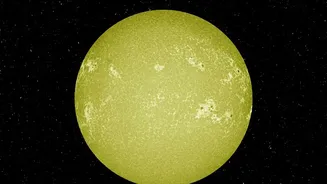
Traditionally, the Sun's domain is defined by the heliosphere—a massive bubble created by the solar wind, a constant stream of charged particles flowing from the Sun. This bubble pushes back against the interstellar medium, the gas and dust that fills the space between stars. The edge of this bubble, the heliopause, has long been considered the final frontier of our solar system, a boundary crossed only by the Voyager 1 and 2 spacecraft. This boundary is incredibly far, with Voyager 1 taking decades to reach it. Green and Belbruno's work suggests we should think bigger.
A New Gravitational Frontier
Instead of focusing on the solar wind, Green and Belbruno's proposal, published in the August 2026 issue of 'ROOM: The Space Journal of Asgardia', looks at gravity. They argue that the true reach of the Sun's influence isn't where its wind dies down, but where its gravitational pull gives way to the broader gravitational field of the Milky Way galaxy itself, including the effects of dark matter. By their calculations, this gravitational boundary extends out to nearly 3.8 light-years. That’s a staggering distance, vastly expanding the conceptual size of our solar system to a scale that nears the distances between neighboring stars. It’s less of a sharp line and more of a complex, dynamic region where cosmic forces are in a delicate balance.
Cosmic Portals and Galactic Slingshots
This new perspective isn't just a thought experiment; it has profound implications for exploration. The proposal identifies specific locations, known as Lagrange points, where the gravitational pull of the Sun and the galaxy are in equilibrium. Green suggests these spots could act like 'portals'. Objects moving slowly through interstellar space could be gently captured by the Sun's gravity in these regions, becoming a permanent part of our solar system. Green is even in discussions with the New Horizons spacecraft team to see if they can observe these distant points to look for accumulated dust, which would help verify their calculations. By understanding these 'weak stability boundaries', as Belbruno calls them, future missions could potentially use them as gateways for both interstellar objects coming in and for our own probes heading out.
The Future of Interstellar Travel?
The concept builds on the proven technique of 'gravity assists', where spacecraft use a planet's momentum to gain speed, like a slingshot. The Voyager missions famously used this to tour the outer planets. Green and Belbruno's idea takes this to its ultimate conclusion: instead of using a planet for a boost, why not use the entire galaxy? A spacecraft propelled by an advanced solar sail could travel to these far-flung gravitational balance points. Once there, it could leverage the massive gravitational pull of the galactic center to be flung outward at incredible speeds, reaching interstellar destinations far faster than conventional methods would allow. This radically rethinks the strategy of deep space exploration, trading fuel for a much longer but far more efficient path that surfs the natural currents of the cosmos.