


A Galactic Haymaker
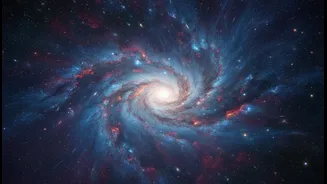
The story of our galaxy's turbulent past revolves around a cataclysmic event that happened roughly 10 billion years ago. Long before Earth was formed, the young Milky Way was struck head-on by another, smaller galaxy. Astronomers have nicknamed the incoming
galaxy 'Gaia-Sausage-Enceladus' (GSE). Despite being a dwarf galaxy, GSE was a heavyweight, packing the mass of more than 10 billion suns in its stars, gas, and dark matter. This wasn't a glancing blow; it was a direct hit that fundamentally reshaped our home galaxy forever.
Flipping The Galactic Disk
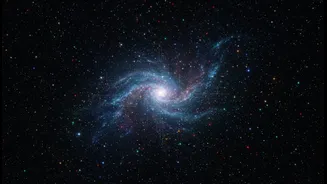
The incredible force of this collision may have caused the entire disk of the Milky Way—the flat plane where our solar system resides—to perform a slow-motion somersault. According to powerful supercomputer simulations, the galaxy's disk likely tilted by more than 90 degrees over hundreds of millions of years following the impact. This dramatic reorientation helps explain a long-standing cosmic puzzle: why the cloud of ancient stars surrounding our galaxy, known as the stellar halo, rotates so much slower than the stars in the main disk. The collision effectively put a brake on the halo's spin while sending the disk into its dramatic flip.
The Cosmic Detectives
So, how did astronomers piece together this ancient cosmic crime scene? The key was data from the European Space Agency's Gaia space telescope. By precisely mapping the positions, movements, and chemistry of over a billion stars, Gaia allowed scientists to identify a population of stars moving in strange, elongated orbits. These were the leftovers of the intruder galaxy, torn to shreds and absorbed by the Milky Way. Researchers at Durham University then used simulations to show that such a head-on collision was the most likely explanation for both the slow-spinning halo and the disk flip. These simulations provided the crucial link between the observed data and the dramatic event in our galaxy's past.
A History of Violence
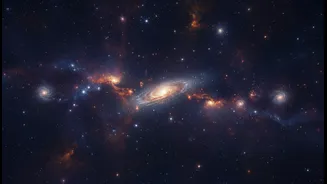
The Gaia-Sausage-Enceladus impact was the last major merger in the Milky Way's history, but it wasn't the only one. Our galaxy has grown by repeatedly consuming smaller galaxies. Another frequent visitor has been the Sagittarius dwarf galaxy, which has punched through our galactic disk several times. These passages, while less dramatic than the GSE merger, have caused ripples and triggered massive bursts of star formation. In fact, some research suggests these ripples may have contributed to the conditions that formed our own Sun. This violent history paints a picture of our galaxy not as a static object, but as a dynamic and constantly evolving environment.
Our Ever-Changing Place in the Cosmos
This discovery fundamentally changes our understanding of the Milky Way's evolution. It means that the very orientation of our galaxy has been shaped by ancient violence. For billions of years, the stars in our galaxy, including our own Sun's ancestors, followed very different paths across the sky. The seemingly stable and orderly cosmos we observe today is built upon a history of immense upheaval. This new chapter in our galaxy's story underscores how much there is still to learn about our cosmic home and the powerful forces that have shaped our place within it.