





An Illusion of Fire
The captivating phenomenon, often called a fire rainbow, is one of the sky's more misleadingly named events. A recent image shared by NASA, featuring a brilliant band of colors parallel to the horizon, showcases this perfectly. The term was likely coined
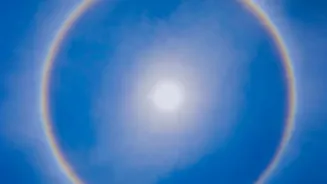
because the vibrant display can look like flames licking the sky, especially when seen through patchy clouds. However, the scientific name is much more descriptive, if less dramatic: a circumhorizontal arc. Unlike a true rainbow, which is formed by the refraction and reflection of light in water droplets and appears opposite the sun, a circumhorizontal arc is a type of ice halo. It forms in the same part of the sky as the sun, just far below it.
The Science of Sun and Ice
The secret to a fire rainbow lies high in the atmosphere, in thin, wispy cirrus clouds. These clouds, which exist at altitudes above 20,000 feet where temperatures are freezing, are not made of water droplets but of millions of tiny, plate-shaped hexagonal ice crystals. For a circumhorizontal arc to form, these flat ice crystals must be suspended horizontally, like tiny floating plates. Sunlight enters the vertical side face of these crystals and is bent, or refracted, as it passes through, before exiting from the horizontal bottom face. This 90-degree path acts like a prism, splitting the white sunlight into its full spectrum of colors, creating the vibrant display we see. The colors are often purer and more intense than those of a regular rainbow.
A Perfect Solar Alignment
Seeing a fire rainbow is a matter of being in the right place at the right time. Besides the need for high-altitude cirrus clouds with correctly aligned ice crystals, the most crucial requirement is the sun's position. The sun must be very high in the sky, at an elevation of more than 58 degrees above the horizon. If the sun is any lower, the light will not hit the ice crystals at the required angle to create the effect. This specific condition means that the phenomenon is impossible to see at latitudes north of 55° N or south of 55° S. In locations where it can be seen, it is most common during the summer months and around midday, when the sun is at its highest point. For example, a city like Los Angeles has many more hours where the sun is high enough compared to London, making sightings much more frequent there.
What Makes NASA's Picture Special
NASA often features images of compelling atmospheric phenomena through its Astronomy Picture of the Day (APOD) service. A recent APOD showcased a particularly stunning fire rainbow over West Virginia, capturing a broad, vivid arc of color beneath a layer of cirrus fibratus clouds. By featuring such images, NASA not only shares beautiful sights from around the world but also provides a platform to explain the underlying science. These pictures serve as perfect case studies, illustrating how specific conditions—like horizontally aligned ice crystals and a high sun—come together to create these unusual and fleeting spectacles. They are a powerful reminder that some of the most extraordinary sights are natural phenomena governed by the laws of physics.
Can You See One in India?
Given India's geographic location, which is well south of the 55° N latitude limit, the conditions for seeing a circumhorizontal arc are certainly possible. The key factors would be the time of year and the time of day. During the summer months, particularly from April to September when the sun is high in the Northern Hemisphere, the chances increase significantly. Observers would need to look for thin, high-level cirrus clouds during the middle of the day, when the sun is at its peak elevation. While not an everyday event, it is far from impossible. Keep an eye on the sky on bright, sunny days with light cloud cover—you might be lucky enough to witness this spectacular display of atmospheric optics firsthand.