






The Dark Side's Communication Problem
The far side of the Moon perpetually faces away from Earth due to a phenomenon called tidal locking. This orientation means there is no direct line of sight for radio signals, creating a communications blackout zone for any mission operating there. In
the past, this has severely limited exploration. During the Apollo era, astronauts experienced communication dropouts whenever they orbited to the far side. For rovers or future human habitats, this lack of constant contact is not just an inconvenience; it's a critical mission risk. Solving this requires a fundamental shift from direct-to-Earth communication to a more robust, networked approach.
Introducing LunaNet: The Lunar Internet
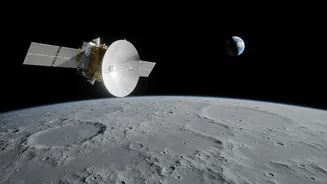
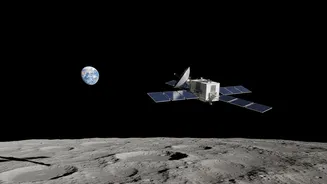
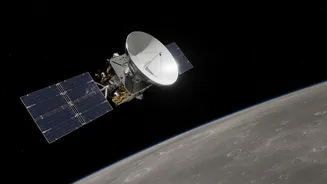
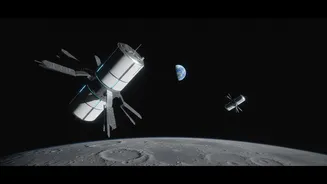
NASA's answer to this challenge is a visionary architecture called LunaNet. Think of it less as a single mission and more as an 'internet' for the Moon, designed to provide reliable navigation and communication services across the entire lunar environment. The plan, developed under the Lunar Communications Relay and Navigation Systems (LCRNS) project, is to establish a network of interconnected satellites orbiting the Moon. These satellites will act as data relay points, effectively building a communications and navigation infrastructure that doesn't depend on a direct link to Earth. This system is being developed in collaboration with international and commercial partners, creating a flexible and scalable network that can grow as lunar activity increases.
How the Relay System Will Work
The concept is elegantly simple. A rover or an astronaut on the far side would send a signal, not towards the blocked Earth, but up to a relay satellite in lunar orbit. That satellite would then transmit the signal to another satellite that has a clear line of sight with Earth, or directly down to a ground station. This store-and-forward capability means data can be handled without needing a continuous, real-time connection, a system known as a Delay/Disruption Tolerant Network (DTN). This network will not only transmit data but also provide crucial Position, Navigation, and Timing (PNT) services, acting like a GPS for the Moon and allowing for autonomous navigation without constant oversight from Mission Control.
Powering the Artemis Generation and Beyond
The immediate beneficiaries of LunaNet are the Artemis missions, which aim to establish a sustained human presence on the Moon. Continuous communication is essential for the safety of astronauts, enabling real-time data streaming, high-definition video, and reliable navigation on the challenging terrain of the lunar South Pole. NASA is partnering with commercial companies through its Commercial Lunar Payload Services (CLPS) initiative to deploy these capabilities. For instance, a 2026 mission by Firefly Aerospace is slated to deliver a communications satellite to lunar orbit as part of its payload. This demonstrates a key shift in strategy: NASA is fostering a commercial ecosystem to build and operate this vital infrastructure.
Unlocking Science and a New Lunar Economy
The implications of constant far-side communication extend far beyond crewed missions. The lunar far side is a uniquely radio-quiet environment, shielded from Earth's constant radio-frequency interference, making it the perfect location for next-generation radio telescopes that could study the universe's cosmic dark ages. With LunaNet, these sensitive instruments can be deployed and operated, sending vast amounts of data back to scientists. Furthermore, this communication backbone is the first essential utility for a future lunar economy. It lays the groundwork for commercial activities like resource prospecting, remote operation of mining equipment, and even tourism, transforming the Moon from a temporary outpost into a permanently connected and economically active world.