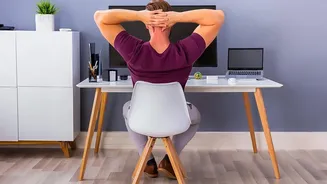








The Anatomy of a Desk Job
The human body is designed for movement, not for being locked in a seated position for eight hours a day. When you sit for extended periods, several things happen. Your hip flexor muscles, which connect your legs to your torso, become shortened and tight,
pulling on your lower back. Simultaneously, your gluteal muscles, which should be supporting your spine, become inactive and weak. This combination often leads to an anterior pelvic tilt, where your pelvis tilts forward, placing significant strain on the lumbar spine and contributing to that all-too-common lower back pain. This static posture doesn't just affect your lower body; it encourages a slouch, causing your shoulders to round forward and your head to push ahead of your spine, leading to neck and shoulder strain.
From Stiffness to Persistent Pain
At first, the effects of sitting might just feel like temporary stiffness that you can shake off. You stand up, stretch, and feel a bit better. However, over time, this repeated stress can lead to more serious issues. The constant pressure on spinal discs can cause them to weaken or bulge, while the ligaments that support your spine can become overstretched. This can progress from simple muscle soreness to persistent, or chronic, pain—a signal that lasts for months and continues long after the initial cause has been addressed. This type of pain is more than just a nuisance; it can impact your mobility, sleep, and overall quality of life.
Why 'Dr. Google' Is Not Enough
When faced with persistent pain, the first instinct for many is to search for solutions online. While general advice on ergonomics and stretching can be a helpful starting point, it's a one-size-fits-all approach to a problem that is deeply individual. The exact cause of your back pain could be different from someone else's, even if the symptoms seem similar. Relying on self-diagnosis can be risky. You might misidentify the root cause, leading you to perform exercises that make the problem worse, or you could be masking the symptoms of a more serious underlying condition that requires specific medical treatment. What feels like a simple muscle strain could be a disc issue, nerve impingement, or something else entirely.
The Crucial Role of Individual Assessment
This is where the second part of the equation becomes critical: persistent pain needs an individual assessment. A qualified healthcare professional, such as a doctor or a physical therapist, can provide a diagnosis that goes beyond your symptoms. They perform a thorough evaluation, which includes discussing your medical history, assessing your posture, testing your range of motion, and checking your muscle strength. This detailed assessment allows them to identify the specific underlying issues—be it muscle imbalances, joint dysfunction, or poor movement patterns—that are contributing to your pain. Only with an accurate diagnosis can you receive a treatment plan that is tailored specifically to you.
Building Better Habits for Your Body
While professional assessment is key for persistent pain, you can take proactive steps to mitigate the effects of sitting. The simplest rule is to move more often. Aim to stand up, stretch, and walk around for a few minutes every 30 to 60 minutes. Pay attention to your workstation ergonomics: your screen should be at eye level, your feet flat on the floor, and your elbows at a 90-degree angle. Incorporate simple stretches for your hips, chest, and shoulders throughout the day. Gentle backbends can help counteract the forward slouch of sitting. These habits won't cure a chronic condition, but they can prevent stiffness from developing into a more significant problem and support the recovery plan your therapist prescribes.