






A Paradox at the Heart of Our Solar System
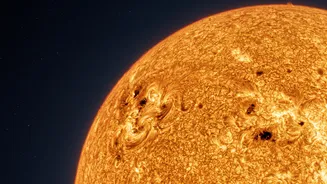
For decades, solar physicists have grappled with a fundamental contradiction. The surface of the sun, known as the photosphere, burns at a scorching but understandable 5,500 degrees Celsius. Logic suggests that as you move away from this heat source,
temperatures should drop. Yet, in the sun’s upper atmosphere, or corona, the opposite happens. Temperatures soar to over a million degrees Celsius. This phenomenon, known as the coronal heating problem, has been one of the greatest unsolved mysteries in astrophysics. Something is transporting enormous amounts of energy from the sun's surface and depositing it into the corona, but the exact mechanism has remained elusive until now.
A New Eye on the Sun
Enter the National Science Foundation's Daniel K. Inouye Solar Telescope. Perched atop Haleakalā in Maui, Hawaii, this four-meter instrument is the largest and most powerful solar telescope on Earth. Its mission is to observe the sun in unprecedented detail, resolving features on its surface as small as 20 kilometers across. For perspective, that’s like seeing an object the size of Manhattan from Earth. This incredible resolution allows scientists to see past the blurry, boiling surface that previous instruments captured, revealing a new layer of complexity in the sun's plasma and magnetic fields.
Spotting the Swirling Vortices
Using the Inouye telescope, scientists have now observed thousands of tiny, previously unseen whirlpools of plasma swirling across the sun’s surface. These structures are found at the edges of solar granules—convection cells where hot plasma rises, cools, and sinks back down. These vortices are signs of a process called Kelvin-Helmholtz instability, which occurs when two fluids flowing past each other at different speeds create a shear at their interface, much like wind creating waves on the ocean. While this phenomenon was theorized to exist on the sun and is seen elsewhere, from clouds on Earth to the atmosphere of Jupiter, this is the first time it has been directly confirmed on the sun's visible surface.
A Hidden Engine for Energy Transfer
This discovery is more than just a novelty; it provides a powerful new mechanism for energy transfer. Scientists believe these tiny, continuous vortices act as engines, twisting and braiding the sun's magnetic field lines. Think of it like repeatedly twisting a rubber band. The vortices continuously inject energy into the magnetic field, building up stress. This stored magnetic energy is then transported upwards into the solar atmosphere. Eventually, the tangled magnetic field lines can snap and reconnect, releasing their stored energy in the form of heat through small bursts of radiation called nanoflares. This process could be the missing link that explains how the corona gets so incredibly hot.
Why Solar Mysteries Matter on Earth
Understanding the fundamental physics of our star is not just an academic exercise. The same magnetic forces that heat the corona are also responsible for solar flares and coronal mass ejections—massive eruptions of plasma that hurtle through space. These events create space weather that can have significant impacts here on Earth, threatening our power grids, disrupting GPS and communications satellites, and posing a risk to astronauts. By deciphering the small-scale processes that drive the sun's larger behavior, scientists can improve their models and better predict these potentially disruptive events, helping to safeguard our increasingly technology-dependent society.