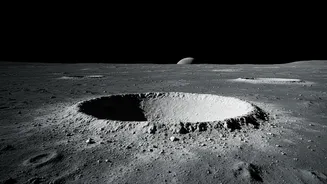








A Moon of Fire and Deception
Io is a place of constant turmoil, a world perpetually stretched and squeezed by the immense gravity of Jupiter. This gravitational tug-of-war, known as tidal heating, generates colossal amounts of internal heat, fueling hundreds of volcanoes that scar
its surface. For decades, scientists have studied this activity primarily using infrared instruments, which could only read the temperature of the very top layer of its crust. This gave us a picture of a world with incredibly hot spots from active eruptions set against a frigid surface. The headline-grabbing discovery from the Juno spacecraft, however, is that some of Io's most seemingly placid, smooth plains are hiding a hot secret just below, challenging our assumptions about how this volcanic world works.
Juno's Unexpected Microwave Vision
The key to this discovery was an instrument that wasn't even primarily designed for this task. Juno's Microwave Radiometer (MWR) was built to peer deep beneath the clouds of Jupiter itself. During an extended mission, scientists turned the MWR towards Jupiter's moons, including Io, during two close flybys in late 2023 and early 2024. To their surprise, the instrument that could probe tens of miles into the icy shells of moons like Europa could also penetrate the rocky surface of Io. By using six different microwave frequencies, the MWR was able to measure thermal emissions from a few inches to tens of feet below the ground, offering the first-ever direct measurement of Io's subsurface temperature.
A Steep Rise in Temperature
Everywhere the MWR looked, it found something remarkable: the temperature increased dramatically just a short distance below the surface. In some areas, the temperature jumped by more than 20 degrees Celsius within just a few feet of the surface. This steep thermal gradient is far more than could be explained by solar heating alone, confirming a huge amount of heat is flowing out from Io's interior across the entire moon. In fact, when measured across the whole moon, the total heat flow is about 30 times greater than that of Earth. This confirmed that Io is losing heat not just through its spectacular volcanic plumes, but through its crust everywhere.
Hidden Lava or a Conductive Crust?
Scientists have two main theories to explain this hidden heat. The first is that the heat is steadily rising upward through a highly conductive crust. The other, more dramatic possibility is that the warmth comes from vast, cooling lava flows buried just 30 to 35 feet beneath a cap of solidified rock. These subsurface lava sheets could cover as much as 10% of the moon's surface at any given time. This finding complicates the old model of a single, global magma ocean, suggesting instead that Io's geology might be a more complex system of localized magma reservoirs and widespread subsurface flows. The data also revealed that Io’s surface is surprisingly smooth in many large areas and has a very low density, more like pumice or volcanic ash than solid rock.
Rewriting the Playbook for Volcanic Worlds
This discovery does more than just add a new chapter to our understanding of Io. It provides a new tool for studying volcanism across the cosmos, including here on Earth. Scientists believe that using similar microwave instruments to study volcanoes on our own planet could reveal similar subsurface heat signatures, potentially offering new insights into how volcanoes work and how to monitor them. By studying the extreme case of tidal heating on Io, researchers can better understand a fundamental process that shapes worlds. This same force is thought to power the subsurface oceans on icy moons like Europa, making the lessons learned from Io's fire crucial for the search for life elsewhere.