

The Galaxy’s Lingering Mystery
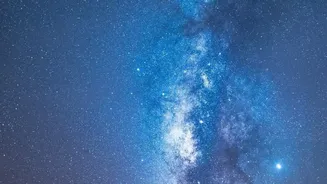
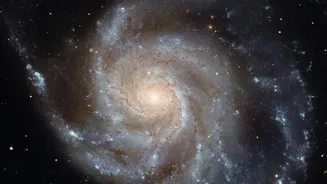
When we picture the Milky Way, we imagine its iconic spiral disc, a bustling metropolis of stars, gas, and dust. This disc rotates at a brisk 220 kilometres per second. But surrounding this disc is a vast, sparse sphere of older stars called the stellar
halo. It’s like the galaxy's quiet, ancient suburbs. Astronomers have long been puzzled by this halo, which drifts around the galactic centre at a comparatively leisurely pace of just 10 to 20 kilometres per second. Most simulations of galaxy formation predict a much faster spin. This discrepancy suggests something in our galaxy's past put the brakes on its outer regions, leaving a puzzle that astronomers are now beginning to piece together.
Meet the Cosmic Culprit
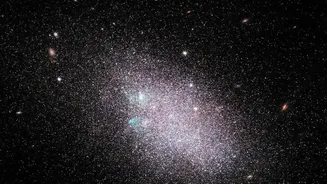
The prime suspect in this cosmic mystery is a now-defunct dwarf galaxy known as Gaia-Sausage-Enceladus, or more informally, the "Gaia Sausage." Around 8 to 11 billion years ago, long before our Sun was born, this smaller galaxy smashed into our own. It wasn't a minor fender-bender; it was a major, defining event in the Milky Way's history. The Gaia Sausage was massive, with a total mass more than 10 billion times that of our sun, and the collision was catastrophic for the interloper. The Milky Way's immense gravity tore it to shreds, absorbing its stars, gas, and globular clusters into its own structure.
Evidence in the Stars
Astronomers can’t rewind time, but they can study the 'fossils' of this ancient crash. The European Space Agency's Gaia satellite, which meticulously maps the positions and movements of billions of stars, was key to the discovery. Researchers noticed a peculiar group of stars moving in extremely elongated, radial orbits—plunging toward the galactic centre and then flying far back out. When they plotted the velocities of these stars, the resulting shape on the graph resembled a sausage, giving the defunct galaxy its unusual name. These "Sausage stars" are the smoking gun, their unique movements and chemical makeup revealing they were not born in the Milky Way but are immigrants from this long-devoured galaxy.
How the Collision Slowed Us Down
So, how did this ancient crash slow the halo down? Recent computer simulations from Durham University provide a compelling explanation. The collision wasn't a simple nudge; it was a dramatic, head-on impact that may have exerted a powerful gravitational torque on the young Milky Way. According to these models, the collision was so violent it could have completely flipped the orientation of the Milky Way's disc by more than 90 degrees over hundreds of millions of years. As the Gaia Sausage galaxy merged with ours, its debris—including many stars on retrograde or opposing orbits—was scattered throughout the halo. This influx of material with different momentum acted like a powerful brake, slowing the halo's overall rotation. The net effect was a cancellation of angular momentum, leading to the slow-spinning halo we observe today.
Rewriting Our Galactic History
Understanding this collision does more than just solve the riddle of the slow-spinning halo. It fundamentally changes how we view our galaxy's formation. It shows the Milky Way wasn't built peacefully but through violent mergers and acquisitions. The Gaia Sausage collision was likely the last major merger in our galaxy's history and was responsible for shaping both the inner bulge and the outer halo. The event also triggered a massive burst of star formation, a galactic "firework" that created many of the star clusters we see today. This new evidence helps astronomers refine their models of how large spiral galaxies like our own come to be, revealing a past far more chaotic and dynamic than once imagined.