






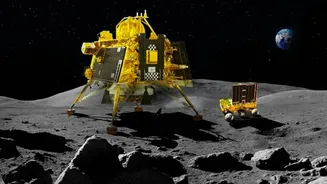

A Mission's Enduring Legacy
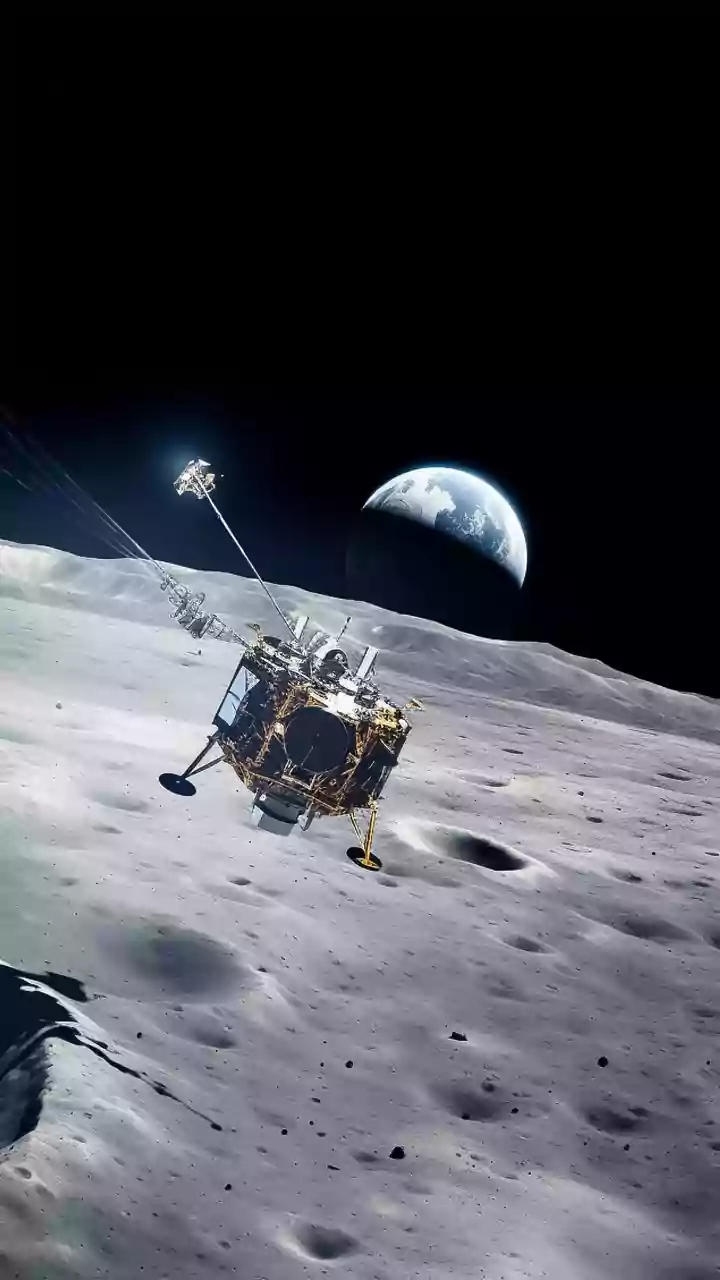
Launched in 2008, Chandrayaan-1 was a landmark achievement for the Indian Space Research Organisation (ISRO) and a turning point in lunar exploration. Though its operational life was shorter than planned, the mission was a resounding success, most famously
providing the first definitive proof of water molecules on the Moon. But its contributions didn't stop there. The spacecraft was equipped with 11 scientific instruments, including the Moon Mineralogy Mapper (M3), a sophisticated imaging spectrometer provided by NASA. This instrument gathered a treasure trove of hyperspectral data, creating a detailed mineralogical map of the entire lunar surface. Years later, this archival data remains an active scientific asset, allowing researchers to make groundbreaking discoveries long after the spacecraft fell silent.
Hunting for a Ghost Crater
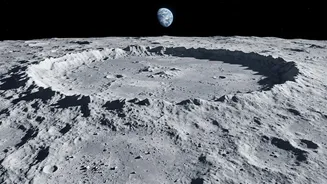
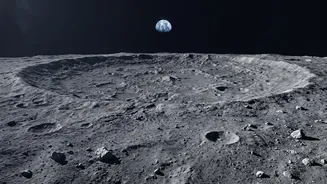
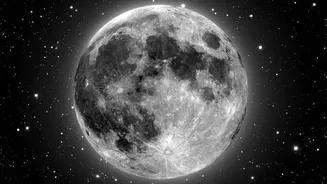
The latest discovery focuses on the Mare Australe region in the Moon’s southeastern hemisphere. Scientists have long suspected that a massive impact basin was hidden there, but they couldn't prove it. The problem is that a crater can be so ancient that billions of years of subsequent smaller impacts, volcanic activity, and surface erosion can completely flatten its physical structure, like a footprint washed away by the tide. Its rims disappear, making it invisible to standard cameras and topographic mapping. It becomes a 'ghost' crater, its existence only hinted at by subtle geological clues. Researchers at the Physical Research Laboratory (PRL) in Ahmedabad decided to hunt for this ghost, not by looking for a physical shape, but by searching for a chemical fingerprint.
The Mineral Fingerprint
The PRL scientists turned to the archival data from Chandrayaan-1’s M3 instrument. Their investigation was like a forensic analysis of a cosmic crime scene. The key piece of evidence they found was a widespread, circular distribution of a mineral called orthopyroxene. This mineral is typically found deep within the Moon's crust or upper mantle and is excavated and thrown outward during a massive impact event. Finding a distinct ring of this material is a strong indicator of a long-vanished basin boundary. The data showed that orthopyroxene-rich material neatly traced the circular pattern of the volcanic ponds in Mare Australe, providing the first solid mineralogical evidence for the obliterated basin, now confirmed as the Australe Basin.
A Tale of Two Basins
The findings, published in The Planetary Science Journal, suggest a complex history involving a dual-impact scenario. The evidence points not only to the completely erased Australe Basin but also to a separate, better-preserved structure called the Australe North Basin. Furthermore, the study revealed that the basalts (volcanic rock) in this region are unusual. Unlike most lunar basalts, which are rich in calcium, the ones in Mare Australe are low in calcium and higher in magnesium. This unique mineralogy suggests a different volcanic history and helps reconstruct the Moon's violent early days. Some evidence even suggests the Australe Basin could be older than the South Pole-Aitken (SPA) basin, which is currently considered the largest and oldest confirmed impact basin on the Moon.
Why This Discovery Matters for India
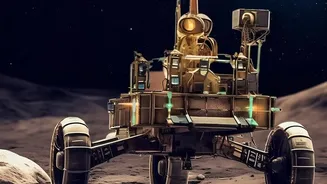
This discovery by PRL scientists is more than just an academic curiosity; it's a testament to the long-term value of India's space program and the expertise of its scientific community. It highlights how investing in space infrastructure pays dividends for decades. The findings also have direct relevance for future missions. Interestingly, the magnesium-rich material identified in the Australe Basin resembles what the Chandrayaan-3 rover detected at its landing site, Shiv Shakti Point. This connection between orbital data and ground-truth measurements helps scientists understand how materials are thrown across vast distances by ancient impacts. This deeper understanding of lunar geology and resource distribution is crucial for planning upcoming missions, such as the Chandrayaan-4 sample return, and for identifying the most promising sites for future exploration.