







What Are AI Medical Scribes?
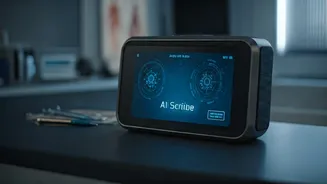
An AI medical scribe is a sophisticated software tool designed to listen to the conversation between a doctor and a patient and automatically generate clinical notes. Using what's called "ambient AI," these systems use a smartphone or a small device in the exam
room to capture the entire interaction. The software then employs advanced speech recognition and natural language processing to transcribe the dialogue, identify medically relevant information, and format it into a structured note for the patient's Electronic Health Record (EHR). The goal is to create a complete, accurate draft that the physician simply needs to review and approve, rather than write from scratch. This transforms the documentation process from a manual, time-consuming task into a streamlined, automated workflow.
A Potential Cure for Doctor Burnout
The administrative burden on physicians is a major contributor to burnout. Studies have shown doctors can spend nearly half of their workday on administrative tasks, with a significant portion dedicated to EHR documentation. This has been dubbed "pajama time"—the hours doctors spend at home, long after their shifts have ended, catching up on paperwork. AI scribes offer a direct solution to this problem. By automating note-taking, they can drastically cut down on documentation time, with some real-world cases showing a reduction of up to two hours per day. This frees up physicians to focus on patient care during work hours, potentially see more patients, and reclaim their personal time, which could significantly improve job satisfaction and reduce burnout.
A Better Experience for Patients
When doctors are less burdened by their keyboards, the quality of patient interaction can improve dramatically. With an AI scribe handling the notes, physicians are free to maintain eye contact, listen actively, and engage more deeply with their patients. This undivided attention not only leads to a better patient experience but can also improve care. Patients may feel more heard and comfortable sharing sensitive information. In one analysis, 47% of patients reported their doctor spent less time looking at a computer, and 39% said their doctor spent more time speaking directly to them when an AI scribe was used. This shift brings the focus of the visit back to the human connection at the heart of medicine.
The Elephant in the Room: Privacy Breaches
The core function of an AI scribe—recording and processing highly sensitive conversations—is also its greatest risk. These recordings and transcripts contain Protected Health Information (PHI), making them a prime target for cyberattacks. Any company providing an AI scribe service is considered a "business associate" under regulations like the US Health Insurance Portability and Accountability Act (HIPAA) and must have stringent security measures in place, including data encryption and secure storage. However, the risk of a data breach is ever-present. A single breach could expose the private medical details of thousands of patients, including diagnoses, treatments, and personal identifiers, leading to potential fraud and immense personal distress.
Hidden Risks Beyond Hacking
The privacy concerns extend beyond malicious breaches. There's the risk of "AI hallucination," where the model generates plausible but false information in the medical record. Algorithms can also exhibit biases, potentially misunderstanding accents, dialects, or specific medical terminology, leading to inaccuracies. Furthermore, there are questions about how this data is used. Patients must give explicit consent for their conversation to be recorded, but they may not fully understand that their anonymised data could be used to train the AI models. There is also the danger of function creep, where data collected for documentation could eventually be used for other purposes, like insurance assessments or marketing, fundamentally eroding patient trust.
The Regulatory Tightrope
Navigating the legal landscape for AI scribes is complex. In India, the Digital Personal Data Protection Act (DPDPA) of 2023 classifies health information as sensitive personal data, requiring explicit consent for collection and processing. Healthcare providers using this technology are considered "Data Fiduciaries" and are responsible for ensuring the data is handled securely and lawfully. However, the specifics of how this applies to ambient AI are still being worked out. Globally, frameworks like HIPAA in the US mandate that vendors sign a Business Associate Agreement (BAA), which legally binds them to protect patient information. However, the responsibility ultimately falls on the healthcare provider to ensure the technology is compliant and that patients are properly informed and have the right to opt-out.