









A New Sentinel in a Special Orbit
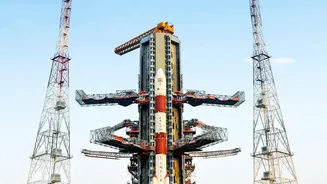
On September 4, 2026, ISRO's Geosynchronous Satellite Launch Vehicle (GSLV-F17) lifted off from Sriharikota, carrying the EOS-05 satellite. What makes this mission exceptional is the satellite's destination: a geosynchronous orbit (GEO) roughly 36,000
kilometres above Earth. EOS-05 is India's first-ever imaging satellite designed to operate from this high perch. Unlike most Earth observation satellites that circle the planet in Low Earth Orbits (LEO) and pass over a location only at certain times, a GEO satellite moves in sync with the Earth's rotation. This allows EOS-05 to remain stationary over the Indian subcontinent, providing continuous, near real-time surveillance of a vast geographical area. The 2,367 kg satellite is a state-of-the-art spacecraft that represents a significant leap in India's remote sensing capabilities.
A Game-Changer for Disaster Management
The ability to constantly monitor a single large area is a game-changer, especially for a country prone to natural disasters. EOS-05 will provide crucial data for tracking the development of cyclones, monitoring floodplains during heavy monsoons, and detecting forest fires as they start. This persistent watchfulness allows for quicker and more effective responses from disaster management agencies, potentially saving lives and property. Before, authorities had to wait for a satellite to pass over an affected area for fresh imagery. Now, with EOS-05, they can have an almost uninterrupted stream of information during rapidly evolving events, enhancing preparedness and supporting recovery efforts.
Boosting Agriculture and Strategic Depth
The applications of EOS-05 extend to critical economic and security sectors. For agriculture, the satellite can monitor crop health, assess soil moisture over large swathes of farmland, and help in resource management. This data is invaluable for policymaking and for improving agricultural productivity. Beyond its civilian uses, EOS-05 provides significant strategic advantages. The ability to maintain a constant watch over the Indian subcontinent and its surrounding maritime regions enhances the nation's security apparatus. This capability for near-continuous border surveillance and monitoring of adjoining areas provides vital strategic data, bolstering India's defensive and observational capacity.
A Story of Resilience and Redemption
The success of the EOS-05 mission is also a powerful story of perseverance for ISRO. This was India's second attempt to place an imaging satellite into a geosynchronous orbit. An earlier mission in August 2021, carrying the EOS-03 satellite, was unsuccessful due to an anomaly in the rocket's upper stage. The triumphant launch of EOS-05 aboard the GSLV demonstrates ISRO's resilience and its mastery over the complex cryogenic engine technology used in the rocket's upper stage. The mission was not only a success for the satellite but also for the GSLV, which carried its heaviest payload yet to this type of orbit, cementing its role as a reliable heavy-lift launcher for India's future space ambitions.