







More Than Just Abs
The side plank is much more than a simple abdominal exercise; it’s a full-body stability challenge. Its primary targets are the obliques, the muscles running along the sides of your torso that are crucial for twisting, bending, and protecting your spine.
But the benefits extend much further. To hold the position, you must engage the gluteus medius, a key muscle on the side of your hip that stabilizes the pelvis. This is vital for single-leg activities like walking and running. Simultaneously, the shoulder of your supporting arm works hard to keep you stable, strengthening the rotator cuff and surrounding muscles. By engaging these three areas—core, hips, and shoulders—the side plank builds functional strength that improves balance, enhances posture, and can help reduce the risk of back injuries.
How to Do It Right
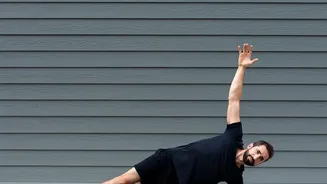
Proper form is non-negotiable for both effectiveness and safety. To perform a classic forearm side plank, lie on your side with your legs extended and feet stacked. Place your forearm on the floor directly under your shoulder, ensuring your elbow is in line. Engage your core and lift your hips toward the ceiling until your body forms a straight, rigid line from your head to your feet. Avoid letting your hips sag or rotating your torso forward or backward. Your head should remain in a neutral position, aligned with your spine, not dropping toward the floor. Think about actively lifting your bottom hip to keep your obliques engaged and prevent your lower back from arching. Hold the position for as long as you can maintain perfect form before carefully lowering down and switching sides.
Good Pain vs. Bad Pain
It's essential to distinguish between productive muscle fatigue and harmful pain. The “good pain” of exercise is typically a burning sensation or tiredness in the belly of the muscle you’re working—in this case, your obliques, glutes, and shoulder. This is often followed by delayed onset muscle soreness (DOMS), a dull, achy feeling that peaks 24 to 72 hours after a workout as your muscles repair and get stronger. In contrast, “bad pain” is often sharp, stabbing, or localized in a joint. If you feel a pinching sensation in your shoulder joint, a sharp twinge in your lower back, or pain in your wrist, that’s your body’s signal to stop immediately. Pushing through this type of pain can lead to injury and is a sign that your form may be incorrect or the exercise is too advanced for your current strength level.
Troubleshooting and Modifications
If you experience pain, the solution isn't to give up but to modify. Shoulder pain often occurs if your elbow is not directly underneath your shoulder, placing undue stress on the joint. Wrist pain in a straight-arm version can be solved by switching to a forearm plank. If the full version feels too intense, there are excellent modifications to build strength gradually. The most common starting point is the modified side plank, where you bend your knees and lift your hips, supporting your body on your forearm and the side of your bottom knee. This reduces the load while still targeting the same muscles. As you get stronger, you can progress by straightening your top leg, and eventually both legs, to build up to the full expression of the pose. Placing extra padding under your forearm can also increase comfort.