









The Invisible Problem in Every Kitchen
Every time you cook, you release more than just delicious aromas into the air. The process of heating food, especially frying or searing, generates smoke, steam, and airborne grease particles. More concerning are the invisible pollutants. Cooking produces
fine particulate matter (PM2.5), which can get deep into your lungs. Gas stoves, common in many Indian homes, also release nitrogen dioxide (NO2) and carbon monoxide (CO), both of which are harmful in high concentrations indoors. These pollutants can worsen respiratory conditions like asthma, irritate your eyes and throat, and contribute to long-term health issues. Without proper ventilation, these contaminants become trapped, lingering long after the meal is over.
Why Small Spaces Suffer More
The core of the issue is concentration. In a large, airy kitchen, cooking fumes have more space to disperse, diluting their intensity. In a small kitchen, the same amount of smoke and pollutants is concentrated in a much smaller volume of air. This means the air quality degrades much faster and more intensely. What might be a minor issue in a large space can quickly become an unhealthy environment in a compact one. The steam and grease also have fewer surfaces to land on, often leading to a sticky film on cabinets, walls, and ceilings, which in turn attracts more dust and grime. Excess moisture from boiling and steaming can also promote mould and mildew growth if not properly vented.
Your Ventilation Toolkit: Chimneys and Fans
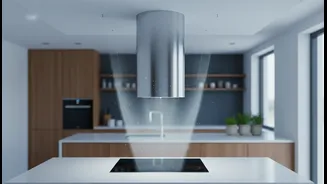
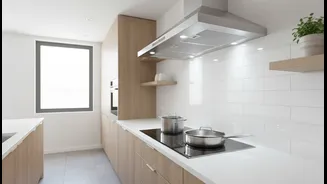
The most effective tool for combating cooking pollution is a range hood, often called a kitchen chimney in India. These appliances are designed to capture smoke, steam, and grease directly at the source, before they can spread. There are two main types. Ducted hoods are the most effective, as they physically pull the contaminated air and vent it outside your home. Ductless, or recirculating, hoods are a practical alternative for apartments or homes where external ducting isn't possible. These work by filtering the air through charcoal and grease filters and then releasing it back into the kitchen. While better than no ventilation, they are less effective at removing heat, moisture, and all pollutants.
Choosing the Right Power for the Job
The power of a kitchen chimney is measured in cubic feet per minute (CFM) or cubic meters per hour (m³/hr). This rating indicates how much air the fan can move. A common mistake is choosing a chimney based on kitchen size alone. The far more important factor is your cooking style and stove type. Heavy Indian cooking, which often involves frying, tadkas, and grilling, requires high suction power to be effective. For a small kitchen with a standard 2-3 burner stove, a 60cm wide chimney is usually sufficient. Look for a suction power in the range of 900-1200 m³/hr to effectively handle the demands of daily Indian cooking, even in a compact space.
Smart Solutions for Compact Kitchens
Even with limited space, there are excellent ventilation options. Wall-mounted chimneys are the most common and space-efficient choice for small kitchens. Look for models with auto-clean technology, which uses heat to liquefy trapped grease, reducing the hassle of manual cleaning—a huge plus for oily cooking. If a full chimney isn't an option, ensure your kitchen has at least an exhaust fan. While not as effective as a range hood, a powerful window-mounted fan can help pull stale air out. For renters, new portable countertop range hoods offer a temporary but effective solution. Regardless of your system, remember to run it every time you cook—even for simple tasks—and clean the filters regularly to maintain performance.