








A Global Recognition of Design
The prestigious Prix Versailles, in its annual announcement at UNESCO headquarters, has unveiled its 2026 selection for the world's most beautiful stations. This year's list celebrates seven passenger stations for their exceptional architecture, creativity,
and seamless integration with their local culture and environment. The jury recognised modern transport hubs in Australia, France, Italy, Saudi Arabia, and the United States, lauding them as "new iconic urban spaces" that blend functionality with breathtaking design. Two stations in Riyadh, Saudi Arabia, made the coveted list, showcasing the nation's investment in futuristic public transport.
Riyadh's Futuristic Landmarks
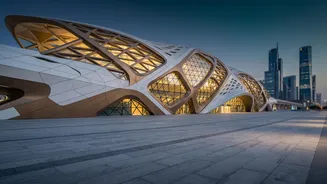
Saudi Arabia secured two spots with its stunning new Riyadh metro stations. The National Museum Station and the Western Station were both praised. The Western Station draws inspiration from desert dunes, with an undulating roofline that shelters not just the tracks but a small ecosystem of shops and public squares. The capital's new metro system is a massive undertaking, featuring other architectural gems like the King Abdullah Financial District (KAFD) Metro Station. Designed by the legendary Zaha Hadid Architects, the KAFD station features a futuristic, wave-like structure that appears to shift like desert sand. Its design, one of Hadid's final projects, creates a multi-level hub that optimizes passenger flow while serving as a landmark of its own.
Melbourne's Cathedral-Like Cavern
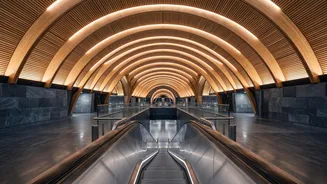
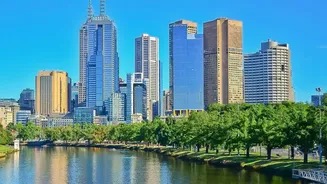
In Australia, Melbourne’s newly opened Town Hall Station captured the jury's attention with its sheer scale and cathedral-like atmosphere. Characterized by dramatic vaulted ceilings and expansive platforms, the design creates a sense of grandeur deep beneath the city streets. This modern marvel joins another iconic Melbourne hub, Southern Cross Station. Though not on this year's list, Southern Cross is famous for its incredible dune-like roof that covers an entire city block. Completed in 2006, its undulating form is not just visually striking but also functional, designed to naturally ventilate fumes from the diesel trains below.
American Ambition in Los Angeles
Representing the United States is the new LAX/Metro Transit Center in Los Angeles. This hub was singled out for its ambitious reinvention of airport transit. The design features sweeping, sculptural canopies engineered to promote natural ventilation and minimize the need for air conditioning. Its commitment to sustainability is further enhanced by solar panels that are expected to cover about half of the building's energy needs. This forward-thinking project stands in contrast to historic US stations like New York's Grand Central Terminal, a Beaux-Arts masterpiece celebrated for its celestial ceiling, grand concourse, and iconic opal-faced clock.
European Elegance: Old and New
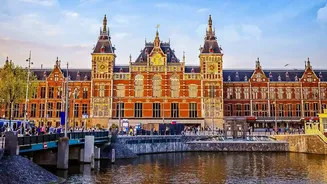
Europe is represented by stations in France and Italy. Lyon Part-Dieu in France was recognized for its role as a vital link between neighborhoods, featuring vast public spaces and the nation's largest bicycle parking facility. Italy boasts two winners: the Colosseo–Fori Imperiali Station in Rome, which turns a commute into an archaeological journey, and the Monte Sant'Angelo Station in Naples. The Naples station, co-designed by artist Anish Kapoor, is a sculptural marvel that descends 48 meters underground, inspired by Dante's Inferno. These contemporary designs join a continent filled with historic 'railway cathedrals' like Antwerp Central in Belgium, a widely admired masterpiece of stone, glass, and iron with a magnificent dome inspired by the Roman Pantheon. Similarly, London's St. Pancras International remains a pinnacle of Victorian Gothic architecture, with its iconic red-brick facade and immense single-span ironwork roof.