





A 400-Year-Old Mistake
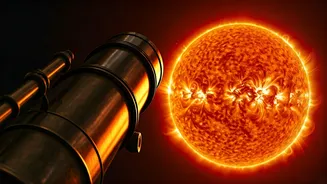
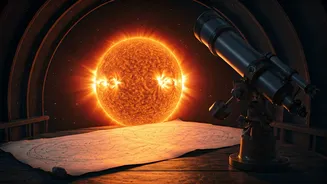
In 1607, long before modern telescopes, the brilliant astronomer Johannes Kepler pointed a device called a camera obscura at the sun. By projecting the sun's image onto paper, he could safely observe it. He noticed a dark spot and, thinking he was making
history, recorded what he believed was the planet Mercury crossing the sun's face. He was wrong. What Kepler actually documented was a large sunspot, and his mistaken sketch is now one of the oldest instrumental records of solar activity we have. For centuries, it was a historical curiosity, but recently, scientists realized this drawing holds a key to understanding one of the sun’s biggest mysteries.
Reading the Sun's Spots
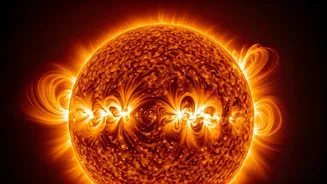
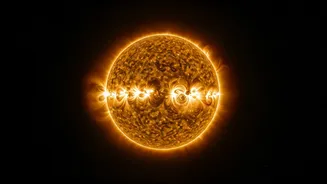
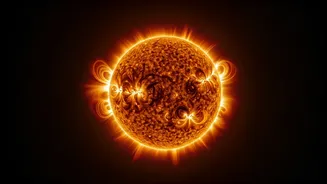
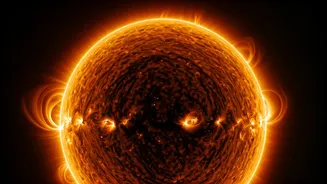
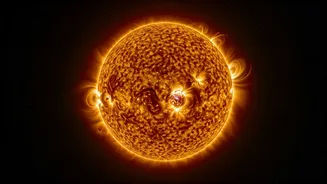
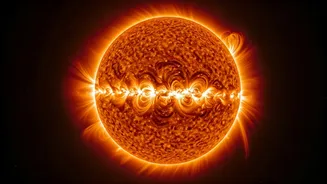
So, what are sunspots? They are dark, relatively cool patches on the sun's surface caused by intense, tangled magnetic fields. These spots are the most visible sign of the sun's activity, which ebbs and flows in a roughly 11-year cycle. During a 'solar maximum', the sun is covered in spots and is more active, releasing solar flares. During a 'solar minimum', the sun's face can be completely blank. This regular rhythm is like the sun's heartbeat. Sunspots also follow a pattern in their location: at the start of a new cycle, they appear at high latitudes (near the sun's poles) and gradually emerge closer to the equator as the cycle progresses toward its end.
The Mystery of the Maunder Minimum
The sun's 11-year cycle is usually reliable. But in the mid-17th century, something strange happened. From about 1645 to 1715, the sunspots almost completely vanished. This 70-year quiet spell is known as the Maunder Minimum. This period of 'solar dimming'—or more accurately, a grand solar minimum—saw a slight reduction in the sun's energy output. Intriguingly, this coincided with a period of cooler temperatures in the Northern Hemisphere known as the 'Little Ice Age', when rivers like the Thames in London regularly froze over. Scientists have long debated what caused this extended solar shutdown and whether the sun's regular cycle sputtered out or just stopped abruptly.
Connecting Past to Present
This is where Kepler's drawing becomes crucial. A recent study, led by researchers from Nagoya University, re-examined the 1607 sketch. By recreating the viewing conditions from Prague, where Kepler made his observation, they could determine the precise location of the sunspot on the solar disk. They found the spot was very close to the sun's equator. According to the rules of solar cycles, a low-latitude spot means the sun was at the very end of its cycle, not the beginning. This small detail is a huge revelation.
What the Study Reveals
The finding suggests that just a few decades before the Maunder Minimum began, the sun's 11-year cycle was behaving completely normally. It wasn't fading or stalling in an unusually long cycle, as some theories had proposed. Instead, it seems the sun was ticking along as usual before it suddenly fell into a prolonged slumber. This helps scientists refine their models of how the sun's internal dynamo—the engine that creates its magnetic field—works. Understanding the transition into a grand solar minimum is essential for predicting if and when it might happen again.
Will the Sun Dim Again?
Some researchers have suggested that based on recent weaker solar cycles, we might be heading for a new grand solar minimum in the coming decades. However, this is a topic of intense debate, and the current solar cycle has been more active than predicted, casting doubt on those forecasts. It is also critical to note that while a grand solar minimum could lead to a slight, temporary cooling effect, scientists overwhelmingly agree it would not be enough to stop or reverse the long-term trend of human-caused global warming. The warming from greenhouse gases is far more powerful than the slight cooling effect from a quiet sun.