

What Exactly Is a 'Fire Rainbow'?
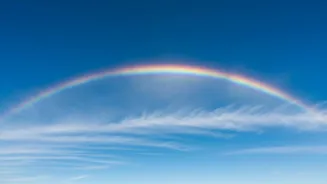
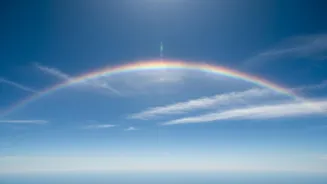
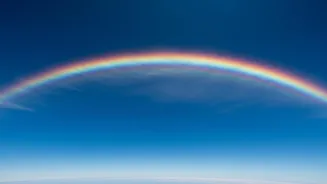
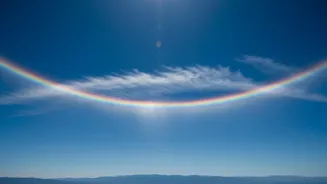
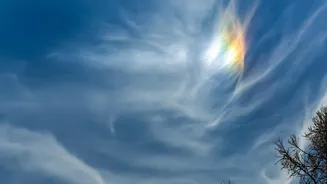
Despite its dramatic name, a "fire rainbow" has nothing to do with fire. The term, likely coined for its flame-like appearance when seen in patchy clouds, is a misnomer. The correct scientific name for this phenomenon is a circumhorizontal arc. It is not a true
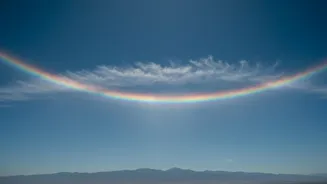
rainbow, which is formed by the refraction and reflection of light within raindrops. Instead, a circumhorizontal arc is a type of ice halo, an optical marvel created by sunlight interacting with ice crystals suspended high in the atmosphere. These arcs appear as broad, colourful bands running parallel to the horizon, often located far below the sun. Their colours are typically more pure and well-separated than those in a common rainbow.
The Crucial Role of the Sun's Angle
The headline's reminder to check the sun's angle is the single most important factor for seeing a circumhorizontal arc. For this phenomenon to occur, the sun must be very high in the sky—specifically, at an altitude of 58 degrees or greater above the horizon. If the sun is any lower than 58 degrees, the geometry is wrong, and the light cannot pass through the ice crystals in the required way to create the arc. This is why circumhorizontal arcs are primarily a summer phenomenon, especially at mid-latitudes, where the sun only reaches this height during the long days around the summer solstice. In fact, at latitudes above 55 degrees north or below 55 degrees south, the sun never gets high enough for a circumhorizontal arc to be visible at all.
A Precise Recipe of Ice and Light
Beyond the high solar angle, two other ingredients are essential. First, you need the right kind of clouds. Circumhorizontal arcs form in high-altitude cirrus or cirrostratus clouds, which are thin, wispy clouds found above 18,000 feet where temperatures are freezing. Because of the cold, these clouds are not made of water droplets but of millions of tiny ice crystals. Second, the shape and orientation of these ice crystals are critical. The crystals must be flat, hexagonal (six-sided) plates, and they must be oriented horizontally, like tiny plates floating flat in the air. Sunlight enters through a vertical side face of the hexagonal crystal and exits through the near-horizontal bottom face. This 90-degree path bends, or refracts, the light, splitting it into its constituent colours just like a prism.
How to Spot Your Own
While considered rare, you can increase your chances of seeing a circumhorizontal arc if you know when and where to look. Your best opportunity is during the middle of the day in the summer months, when the sun is at its highest point in the sky. Keep an eye out for the presence of thin, wispy cirrus clouds. Since the arc forms below the sun, you should look in that direction, but remember to never look directly at the sun. Using a hand or building to block the sun's direct glare is a safe way to scan the surrounding sky. Wearing polarizing sunglasses can also help make a faint arc more visible by reducing glare. Unlike cloud iridescence, which can appear in various parts of the sky, a circumhorizontal arc always has a fixed location relative to the sun, making it a predictable, if uncommon, target for sky-watchers.